
On this page
- Which AI models are compared here?
- AI models comparison table: specs and prices
- How do the top models score on benchmarks?
- Which AI model is best for each job?
- Claude models compared: Fable 5.1 vs Opus 5.5 vs Sonnet 5.5 vs Haiku 5.5
- GPT models compared: GPT-6 Astra vs GPT-6.1 Sol vs GPT-6 Luna
- Gemini models compared: Gemini 4 Argon vs 3.8 Flash vs Flash-Lite
- Grok models compared: Grok 4.7 vs Grok 4.6 vs Grok 4.3
- DeepSeek V4.1 Flash vs DeepSeek V4 Pro
- Qwen models compared: Qwen3.8-Max vs Qwen3.7-Plus vs Qwen3.8-Flash
- Kimi K3 and GLM-5.3: the other open-weight leaders
- Open-weight vs closed AI models: which can you host yourself?
- What does each model cost for a real workload?
- Which AI models can you use in Pakistan, and at what price?
- Why do benchmark scores differ between companies?
- How we use these models in our own work
- Common mistakes when choosing an AI model
- Summary
- References
In an AI models comparison for October 2026, no single model wins everything. On each maker’s own published tests, Claude Opus 5.5 leads agentic coding, GPT-6 Astra leads maths, science and computer use, and Gemini 4 Argon leads very long documents and finance and legal work. For cheap, high-volume jobs, Claude Haiku 5.5 and GPT-6 Luna cost US$0.10 per million input tokens. Among models you can download and host yourself, DeepSeek V4.1 Flash (MIT licence) scores higher than Kimi K3 and GLM-5.3 on nearly every test in DeepSeek’s own comparison.
This guide compares more than 40 models from eight makers: Anthropic (Claude), OpenAI (GPT), Google (Gemini), xAI (Grok), DeepSeek, Alibaba (Qwen), Moonshot AI (Kimi) and Z.ai (GLM). It covers the current lineups and the older models people still ask about, such as Claude Opus 4.6, Sonnet 4.6 and Gemini 3.1 Pro. Every spec, price and score comes from the maker’s own documentation, pricing page, launch post or model card, read on 22 October 2026, and every benchmark says who reported it. We did not run the benchmarks ourselves. We do use several of these models every day to build software, and near the end we explain how we split work between them.
Which AI models are compared here?
Each company sells a family: a large flagship for the hardest work, a balanced middle model most people should start with, and a small, cheap model for high volume. Four of the eight also release the weights of their best models, so you can run them on your own servers.
| Maker | Flagship | Balanced | Fast and cheap | Open weights |
|---|---|---|---|---|
| Anthropic (Claude) | Claude Fable 5.1, Claude Opus 5.5 | Claude Sonnet 5.5 | Claude Haiku 5.5 | No |
| OpenAI (GPT) | GPT-6 Astra | GPT-6.1 Sol | GPT-6 Luna | Only gpt-oss-120b and gpt-oss-20b |
| Google (Gemini) | Gemini 4 Argon | Gemini 3.8 Flash | Gemini 3.5 Flash-Lite | Not for Gemini models |
| xAI (Grok) | Grok 4.7 | Grok 4.3 | Grok Build 0.1 (coding) | Not for current models |
| DeepSeek | DeepSeek V4 Pro, V4.1 Flash | DeepSeek V4.1 Flash | DeepSeek V4.1 Flash (off-peak) | Yes, MIT licence |
| Alibaba (Qwen) | Qwen3.8-Max | Qwen3.7-Plus | Qwen3.8-Flash | Yes, several licences |
| Moonshot AI (Kimi) | Kimi K3 | Kimi K2.6 | None listed | Yes, Kimi K3 licence |
| Z.ai (GLM) | GLM-5.3 | GLM-5.3-FlashX | GLM-5.3-Flash | Yes, GLM-5.3 licence |
xAI is now part of SpaceX: its news page carries the announcement “SpaceX announced today that it has acquired xAI”, and the site now uses the name SpaceXSI. We use xAI here because that is the name most people search for.
AI models comparison table: specs and prices
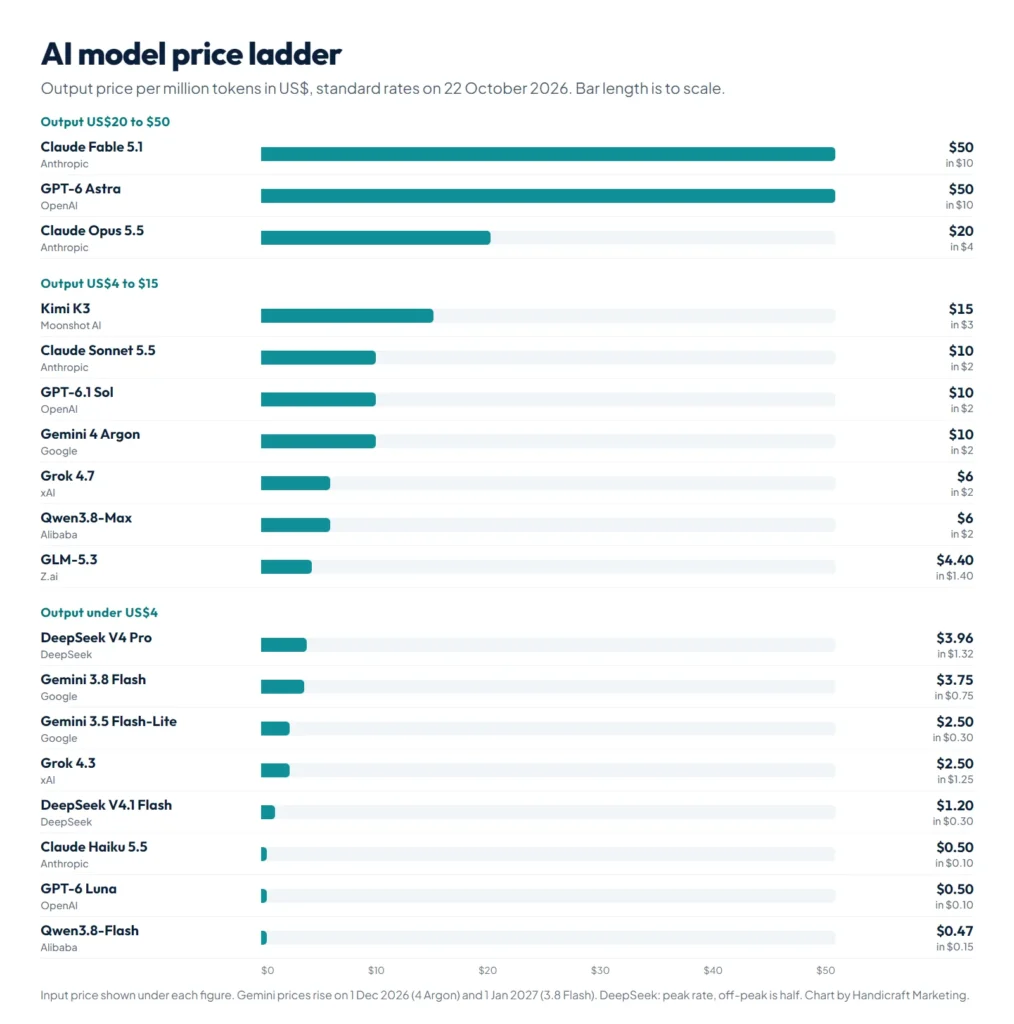
The table lists the current models that matter most, with standard API prices in US dollars per million tokens (input / output), before caching and batch discounts. “Released” is the launch or general-availability date on the maker’s own changelog or launch post.
| Model | Maker | Released | Context window | Max output | Price in / out | Open weights |
|---|---|---|---|---|---|---|
| Claude Fable 5.1 | Anthropic | 1 Sep 2026 | 1M | 128K | $10 / $50 | No |
| Claude Opus 5.5 | Anthropic | 22 Sep 2026 | 1M | 128K | $4 / $20 | No |
| Claude Sonnet 5.5 | Anthropic | 28 Sep 2026 | 1M | 128K | $2 / $10 | No |
| Claude Haiku 5.5 | Anthropic | 7 Oct 2026 | 1M | 128K | $0.10 / $0.50 (prompts up to 100K) | No |
| GPT-6 Astra | OpenAI | 3 Sep 2026 | 1.05M (922K input) | 128K | $10 / $50 | No |
| GPT-6.1 Sol | OpenAI | 29 Sep 2026 | 1.05M (922K input) | 128K | $2 / $10 | No |
| GPT-6 Luna | OpenAI | 22 Sep 2026 | 1.05M (922K input) | 128K | $0.10 / $0.50 | No |
| Gemini 4 Argon | 13 Oct 2026 | 1,048,576 | 65,536 (1M with long decode) | $2 / $10 to 30 Nov, then $4 / $20 | No | |
| Gemini 3.8 Flash | 2 Sep 2026 | 1,048,576 | 65,536 | $0.75 / $3.75 to 31 Dec, then $1.50 / $7.50 | No | |
| Gemini 3.5 Flash-Lite | 21 Jul 2026 | 1,048,576 | 65,536 | $0.30 / $2.50 | No | |
| Grok 4.7 | xAI | 21 Sep 2026 | 500K | Not stated | $2 / $6 (prompts under 200K) | No |
| Grok 4.3 | xAI | Not stated | 1M | Not stated | $1.25 / $2.50 (prompts under 200K) | No |
| DeepSeek V4.1 Flash | DeepSeek | 17 Oct 2026 | 1M | 384K | $0.30 / $1.20 peak, half off-peak | Yes (MIT) |
| DeepSeek V4 Pro | DeepSeek | 13 Aug 2026 | 1M | 384K | $1.32 / $3.96 peak, half off-peak | Yes (MIT) |
| Qwen3.8-Max | Alibaba | 2 Aug 2026 | 1M | Not stated | $2 / $6 | Yes (Qwen licence) |
| Qwen3.8-Flash | Alibaba | 26 Aug 2026 | 1M | Not stated | $0.15 / $0.47 | Yes (as Qwen3.8-Flash-Next) |
| Kimi K3 | Moonshot AI | July 2026 | 1,048,576 | Not stated | $3 / $15 | Yes (Kimi licence) |
| GLM-5.3 | Z.ai | August 2026 | 1M | 128K | $1.40 / $4.40 | Yes (GLM licence) |
Qwen prices are Alibaba Cloud’s International list prices. Gemini’s scheduled price rises are already on Google’s pricing page. Three details are easy to miss: GPT-6 models accept at most 922,000 input tokens even though the context window is 1.05 million, prompts over 272,000 tokens cost twice the input rate and 1.5 times the output rate on GPT-6, and Grok bills a whole request at its higher rate once the prompt reaches 200,000 tokens.
How do the top models score on benchmarks?
Benchmarks are the only way to compare models at scale, but every company runs them a little differently: different test versions, different agent tools around the model, and different “effort” settings that let a model think longer. The table below uses four tests that appear in most of the companies’ tables. Each figure is the one the model’s own maker published; a figure marked with an asterisk comes from another company’s table, because the maker did not publish one.
| Model | Terminal-Bench 4.0 (agentic coding) | DeepSWE v1.1 (software engineering) | Humanity’s Last Exam, with tools | GPQA Diamond (science) |
|---|---|---|---|---|
| Claude Opus 5.5 | 66.4% | 74.2%* | 67.7% | Not published |
| Claude Sonnet 5.5 | 70.6% | Not published | 64.5% | Not published |
| Claude Fable 5.1 | 55.8% | 67.4%* | 65.6% | 93.7%* |
| Claude Haiku 5.5 | 39.2% | Not published | 57.4% | Not published |
| GPT-6 Astra | 57.9% | 74.1% | 57.2% | 96.0% |
| GPT-6 Luna | 16.4%* | 66.6% | Not published | Not published |
| Gemini 4 Argon | 57.4% | 77.9% | Not published | Not published |
| Gemini 3.8 Flash | 19.1% | 73.7% | Not published | 95.3%* |
| Grok 4.7 | 37.6% | 71.0% (high effort) | Not published | Not published |
| DeepSeek V4.1 Flash | 42.3% | 77.0% | 63.9% | 90.9% |
| Qwen3.8-Max | Not published | 56.6% | 56.2% | 92.6% |
| Kimi K3 | 12.6%* | 67.5% | 56.0% | 93.5% |
| GLM-5.3 | 37.9%* | 66.9% | 62.5% | Not published |
Sources: Anthropic’s Claude launch posts; OpenAI’s GPT-6 Astra and GPT-6 Sol and Luna posts; Google’s Gemini 4 Argon and 3.8 Flash model cards; xAI’s Grok 4.7 post; DeepSeek’s, Qwen’s, Kimi’s and Z.ai’s model cards on Hugging Face. Asterisks: Opus 5.5 DeepSWE from Google’s Argon card; Fable 5.1 DeepSWE and GPQA and Gemini 3.8 Flash GPQA from OpenAI’s Astra post; GPT-6 Luna Terminal-Bench from Anthropic’s Haiku 5.5 post; Kimi K3 and GLM-5.3 Terminal-Bench from DeepSeek’s V4.1 Flash card. DeepSeek’s DeepSWE and Terminal-Bench figures are for the 17 October update (V4.1-Flash-1017); its GPQA and Humanity’s Last Exam figures are for the September V4.1 Flash.
Three things stand out. Claude Sonnet 5.5 and Opus 5.5 top Terminal-Bench 4.0, the agentic coding test where scores are lowest overall, and the cheaper Sonnet 5.5 scores higher than Opus 5.5 on it. Gemini 4 Argon and DeepSeek’s V4.1 Flash post the best DeepSWE scores. And on GPQA Diamond, a graduate-level science quiz, almost every flagship now scores above 90%, so it no longer separates the top models.
Which AI model is best for each job?
Pick the model by the work you do most. Each row gives a first pick, a cheaper or close alternative and the published result that supports it.
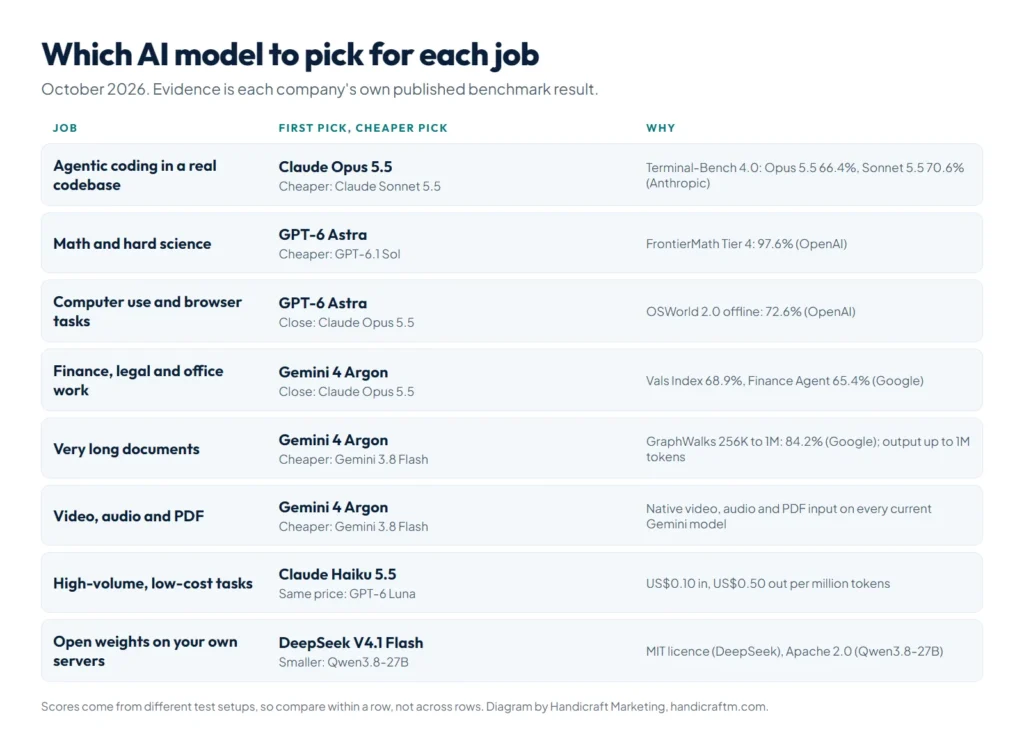
| Your main job | First pick | Cheaper or close pick | Evidence |
|---|---|---|---|
| Agentic coding in a real codebase | Claude Opus 5.5 | Claude Sonnet 5.5 | Terminal-Bench 4.0: 66.4% and 70.6%; CursorBench 4.0: 57.8% and 55.5% (Anthropic) |
| Maths and hard science | GPT-6 Astra | GPT-6.1 Sol | FrontierMath Tier 4: 97.6%; Terminal-Bench Science at US$5.47 a task on 6.1 Sol against US$23.80 on Astra (OpenAI) |
| Computer use and browser tasks | GPT-6 Astra | Claude Opus 5.5 | OSWorld 2.0 offline: 72.6% (OpenAI); Opus 5.5 scores 81.8% (partial score) on OSWorld 2.1 (Anthropic) |
| Finance, legal and office work | Gemini 4 Argon | Claude Opus 5.5 | Vals Index 68.9% and Vals Finance Agent 65.4% (Google); GDPval-AA 1846 Elo for Opus 5.5 (Anthropic) |
| Very long documents | Gemini 4 Argon | Gemini 3.8 Flash | GraphWalks from 256K to 1M tokens: 84.2% against 71.8% for Astra and 66.8% for Opus 5.5 (Google) |
| Video, audio and PDF files | Gemini 4 Argon | Gemini 3.8 Flash | Every current Gemini model takes text, image, video, audio and PDF; Claude, GPT-6 and Grok list text and image |
| High-volume, low-cost tasks | Claude Haiku 5.5 | GPT-6 Luna | Same price; Anthropic’s table shows Haiku 5.5 ahead of Luna on GDPval-AA (1620 against 1437) and OSWorld 2.1 (72.4% against 48.9%) |
| Open weights on your own servers | DeepSeek V4.1 Flash | Qwen3.8-27B or gpt-oss-120b | MIT licence and 77.0% on DeepSWE (DeepSeek); Qwen3.8-27B and gpt-oss use Apache 2.0 |
| Free to start | Gemini 3.8 Flash API | ChatGPT Free, Grok free tier | Google lists the Flash models as free of charge on its free API tier, where your content may be used to improve its products |
For everyday writing and chat there is no reliable public benchmark, so try the same brief in two or three apps and keep the one whose drafts need the fewest edits.
Claude models compared: Fable 5.1 vs Opus 5.5 vs Sonnet 5.5 vs Haiku 5.5
All four current Claude models read 1 million tokens, write up to 128,000 tokens per reply, accept text and images, and have a reliable knowledge cutoff of June 2026. They differ in price, speed and depth. Anthropic’s own advice is direct: “start with Claude Opus 5.5 for most workloads”.
| Model | Anthropic says it is for | Price in / out | Speed (Anthropic) | Default effort |
|---|---|---|---|---|
| Claude Fable 5.1 | Demanding reasoning and long-horizon agentic work | $10 / $50 | Slower | High |
| Claude Opus 5.5 | Long-running agentic coding and knowledge work | $4 / $20 | Moderate | Medium |
| Claude Sonnet 5.5 | The best combination of speed and intelligence | $2 / $10 | Fast | High |
| Claude Haiku 5.5 | High-volume, latency-sensitive tasks such as classification, extraction and routing | $0.10 / $0.50 | Fastest | Medium |
Opus 5.5 is the surprise of this lineup. In Anthropic’s launch table it scores higher than the more expensive Fable 5.1 on all nine listed tests, including Terminal-Bench 4.0 (66.4% against 55.8%), FrontierCode (54.4% against 50.3%), GDPval-AA knowledge work (1846 against 1735 Elo) and Humanity’s Last Exam with tools (67.7% against 65.6%). Anthropic says it “performs at the level of Claude Fable 5.1 on most work and costs 40% less to run than Opus 5”, and still recommends Fable 5.1 when your own tests on Opus 5.5 at higher effort fall short. A fast mode doubles the price to US$8 and US$40.
Sonnet 5.5 runs “30%+ faster” than Sonnet 5 and is, in Anthropic’s words, “strongest at well-scoped everyday tasks, fixing bugs, and creating polished documents, slides, and spreadsheets”. It beats Opus 5.5 on Terminal-Bench 4.0 (70.6%) and comes within two points of it on GDPval-AA. Anthropic still says Opus 5.5 “remains clearly stronger at complex, open-ended work requiring sustained judgment”.
Haiku 5.5 is “the cheapest, fastest, and most capable small model” Anthropic has released, and costs about 75% less to run than Haiku 4.5. Watch the price step: prompts over 100,000 tokens cost US$0.50 in and US$2.50 out, five times the base rate. Anthropic also says it “pairs well with Opus 5.5 and Sonnet 5.5 as a subagent on coding work”, which is how we use it in Claude Code subagents.
If you move code from Opus 5 to Opus 5.5, read the migration notes first: Anthropic lists four breaking changes, including that thinking can no longer be turned off and forced tool use now returns an error.
Older Claude models: Opus 4.6, Sonnet 4.6, Opus 5 and Haiku 4.5
Older Claude models stay on the API as “legacy” for at least a year after launch. They still work, but most now cost more than the newer models that replace them, and they know less about recent events.
| Model | Released | Price in / out | Context | Reliable knowledge cutoff | Retirement |
|---|---|---|---|---|---|
| Claude Opus 5 | 24 Jul 2026 | $5 / $25 | 1M | May 2026 | Not before 24 Jul 2027 |
| Claude Sonnet 5 | 30 Jun 2026 | $2 / $10 | 1M | Jan 2026 | Not before 30 Jun 2027 |
| Claude Fable 5 | 9 Jun 2026 | $10 / $50 | 1M | Jan 2026 | Not before 9 Jun 2027 |
| Claude Opus 4.8 | 28 May 2026 | $5 / $25 | 1M | Jan 2026 | Not before 28 May 2027 |
| Claude Sonnet 4.6 | 17 Feb 2026 | $3 / $15 | 1M | Aug 2025 | Not before 17 Feb 2027 |
| Claude Opus 4.6 | 5 Feb 2026 | $5 / $25 | 1M | May 2025 | Not before 5 Feb 2027 |
| Claude Opus 4.5 | 24 Nov 2025 | $5 / $25 | 200K | May 2025 | Not before 24 Nov 2026 |
| Claude Haiku 4.5 | 15 Oct 2025 | $1 / $5 | 200K | Feb 2025 | Not before 15 Oct 2026 |
| Claude Sonnet 4.5 | 29 Sep 2025 | $3 / $15 | 200K | Jan 2025 | Deprecated, retirement notice sent 30 Sep 2026 |
The pattern is clear: Opus 4.6 costs US$5 and US$25 per million tokens, while Opus 5.5 costs US$4 and US$20, and its knowledge runs about a year later. Haiku 4.5 costs ten times the base price of Haiku 5.5. Keep an older model only while you test the new one on your own prompts. For how Opus 4.6 and Sonnet 4.6 compared with Gemini and GPT models of the same generation, see the Gemini 3.1 Pro section below.
GPT models compared: GPT-6 Astra vs GPT-6.1 Sol vs GPT-6 Luna
OpenAI’s docs sum up the lineup: “use GPT-6 Astra, our flagship model for complex reasoning and coding. Choose GPT-6.1 Sol to balance intelligence and cost, or GPT-6 Luna for cost-sensitive, high-volume workloads.” All three read 1,050,000 tokens of context, accept up to 922,000 input tokens, write up to 128,000 tokens and take text and images.
| Model | Released | Price in / cached / out | Knowledge cutoff | Reasoning effort |
|---|---|---|---|---|
| GPT-6 Astra | 3 Sep 2026 | $10 / $1 / $50 | 30 Apr 2026 | Low to max (no “none”) |
| GPT-6.1 Sol | 29 Sep 2026 | $2 / $0.10 / $10 | 30 Apr 2026 | Low to max, default medium |
| GPT-6 Luna | 22 Sep 2026 | $0.10 / $0.01 / $0.50 | 18 May 2026 | None to max, default medium |
GPT-6 Astra is OpenAI’s “most capable model for the most demanding work”. OpenAI’s launch tables give it 97.6% on FrontierMath Tier 4, 95.0% on ARC-AGI-2, 72.6% on OSWorld 2.0 computer use, 92.7% on ScreenSpot-Pro and 96.3% on its own 8-needle long-context test from 512K to 1M tokens. OpenAI also reports fewer errors: 4.2% on its internal hallucination test against 12.2% for GPT-5.6 Sol. Note one honest detail in OpenAI’s own table: on the Artificial Analysis Intelligence Index it lists Claude Fable 5.1 at 65.7 and Astra at 61.2. Astra meets OpenAI’s “Critical” cybersecurity threshold, so at launch it refuses some security work, such as writing proof-of-concept exploits.
GPT-6.1 Sol “nearly matches GPT-6 Astra’s intelligence on agentic coding, computer use, and professional work at one-fifth of Astra’s standard input and output token prices”, in OpenAI’s words. On Terminal-Bench Science, OpenAI puts its cost at US$5.47 per task against US$23.80 for Astra. In ChatGPT it is available to paid users in ChatGPT Work and Codex, but OpenAI says it is “not yet available in Chat”.
GPT-6 Luna is the efficiency model: US$0.10 in and US$0.50 out, with cached input at US$0.01. OpenAI reports 66.6% on DeepSWE at max effort and says Free and Go users can use Luna in the ChatGPT desktop app.
Older GPT models: GPT-6 Sol, GPT-5.6, GPT-5.5 and GPT-5.4
| Model | Released | Price in / out | Knowledge cutoff | Note |
|---|---|---|---|---|
| GPT-6 Sol | 22 Sep 2026 | $2 / $10 | 20 Apr 2026 | Replaced by GPT-6.1 Sol at the same price |
| GPT-5.6 Sol | 9 Jul 2026 | $4 / $20 | 16 Feb 2026 | Promotional price “at least through November 21, 2026” |
| GPT-5.6 Terra | 9 Jul 2026 | $2 / $12 | 16 Feb 2026 | The old “mini” tier |
| GPT-5.5 | 24 Apr 2026 | $5 / $30 | 1 Dec 2025 | Costs more than GPT-6 Sol and knows less |
| GPT-5.4 | 5 Mar 2026 | $2.50 / $15 | 31 Aug 2025 | Default reasoning effort “none” |
As with Claude, the newer models are cheaper. GPT-6 Sol and Luna launched at 50% below the GPT-5.6 promotional prices, according to OpenAI.
Gemini models compared: Gemini 4 Argon vs 3.8 Flash vs Flash-Lite
Google’s lineup has one clear advantage: every current Gemini model accepts text, images, video, audio and PDF as input. Claude, GPT-6 and Grok list text and image only. All of them read 1,048,576 tokens.
| Model | Released (GA) | Price in / out | Max output | Free API tier |
|---|---|---|---|---|
| Gemini 4 Argon | 13 Oct 2026 | $2 / $10 to 30 Nov 2026, then $4 / $20 | 65,536, or up to 1,048,576 with long decode | No |
| Gemini 3.8 Flash | 2 Sep 2026 | $0.75 / $3.75 to 31 Dec 2026, then $1.50 / $7.50 | 65,536 | Yes |
| Gemini 3.6 Flash | 21 Jul 2026 | Same as 3.8 Flash | 65,536 | Yes |
| Gemini 3.5 Flash-Lite | 21 Jul 2026 | $0.30 / $2.50 | 65,536 | Yes |
| Gemini 3.1 Flash-Lite | 7 May 2026 | $0.25 / $1.50 | 65,536 | Yes |
| Gemini 3.1 Pro (Preview) | 19 Feb 2026 (preview) | $2 / $12 up to 200K, $4 / $18 above | 65,536 | No |
Gemini 4 Argon is Google’s “flagship reasoning model, built for complex software engineering, deep mathematical and scientific problem solving, autonomous multi-step agents, and long decode up to 1M tokens”. Long decode is unusual: it can write a reply of up to a million tokens, where Claude and GPT-6 stop at 128,000. Google’s model card compares it directly with GPT-6 Astra, Claude Fable 5.1 and Claude Opus 5.5:
| Test (Google’s figures) | Gemini 4 Argon | GPT-6 Astra | Claude Fable 5.1 | Claude Opus 5.5 |
|---|---|---|---|---|
| Vals Index (knowledge work) | 68.9% | 63.1% | 65.8% | 67.0% |
| AutomationBench (business workflows) | 51.3% | 41.4% | 31.4% | 42.5% |
| Vals Finance Agent v2 | 65.4% | 53.5% | 58.9% | 58.6% |
| DeepSWE v1.1 | 77.9% | 74.1% | 67.4% | 74.2% |
| FrontierSWE v2 | 55.0% | 65.5% | 56.3% | 62.3% |
| Terminal-Bench 4.0 | 57.4% | 58.2% | 57.9% | 66.4% |
| Terminal-Bench Science 0.1 | 57.6% | 68.1% | 52.6% | 63.3% |
| GraphWalks, 256K to 1M tokens | 84.2% | 71.8% | 65.0% | 66.8% |
| LVBench (long video) | 91.7% | 87.5% | 79.7% | 83.7% |
Argon wins most of Google’s own rows, but not coding in the terminal, science or FrontierSWE. Its price doubles on 1 December 2026, and it is not on Google’s free tier.
Gemini 3.8 Flash is Google’s “most intelligent Flash model”. Its model card shows it level with Claude Opus 5 on DeepSWE (73.7% against 74.0%) at a fraction of the price, but far behind on Terminal-Bench 4.0 (19.1% against 51.8%). It is free on the API’s free tier, which makes it the cheapest way to prototype. Google’s knowledge cutoff for both 3.8 Flash and Gemini 4 is March 2026.
Gemini 3.1 Pro vs Claude Opus 4.6 vs Sonnet 4.6: the previous generation
Many people still compare the early-2026 models. Google’s Gemini 3.1 Pro model card, from February 2026, tested it against Claude Opus 4.6, Claude Sonnet 4.6 and GPT-5.2:
| Test (Google’s figures) | Gemini 3.1 Pro | Claude Opus 4.6 | Claude Sonnet 4.6 | GPT-5.2 |
|---|---|---|---|---|
| Humanity’s Last Exam, no tools | 44.4% | 40.0% | 33.2% | 34.5% |
| ARC-AGI-2 | 77.1% | 68.8% | 58.3% | 52.9% |
| GPQA Diamond | 94.3% | 91.3% | 89.9% | 92.4% |
| Terminal-Bench 2.0 | 68.5% | 65.4% | 59.1% | 54.0% |
| SWE-Bench Verified | 80.6% | 80.8% | 79.6% | 80.0% |
| GDPval-AA (Elo) | 1317 | 1606 | 1633 | 1462 |
| BrowseComp | 85.9% | 84.0% | 74.7% | 65.8% |
| MMMLU (multilingual) | 92.6% | 91.1% | 89.3% | 89.6% |
So in early 2026, Gemini 3.1 Pro led on reasoning puzzles and science, Opus 4.6 matched it on SWE-Bench Verified coding, and both Claude models led clearly on GDPval-AA office work. Today Gemini 3.1 Pro is still a preview model and costs more for output (US$12) than Gemini 4 Argon (US$10 until 30 November), while Opus 4.6 costs more than Opus 5.5. Both have been overtaken by their own makers’ newer models.
Grok models compared: Grok 4.7 vs Grok 4.6 vs Grok 4.3
xAI’s docs keep the choice short: “For everything else, including code, use Grok 4.7. It is the most capable model we’ve built.” Grok 4.7 launched on 21 September 2026 on “a new, larger base model compared to Grok 4.6”, with a knowledge cutoff of May 2026.
| Model | Context | Price in / cached / out (under 200K) | Above 200K | Best for |
|---|---|---|---|---|
| Grok 4.7 | 500,000 | $2 / $0.50 / $6 | $4 / $1 / $12 | Coding, agents and knowledge work |
| Grok 4.6 | 500,000 | $2 / $0.50 / $6 | $4 / $1 / $12 | Previous version, same price |
| Grok 4.3 | 1,000,000 | $1.25 / $0.20 / $2.50 | $2.50 / $0.40 / $5 | “Fast, reliable model with strong tool calling” |
| Grok Build 0.1 | 256,000 | $1 / $0.20 / $2 | $2 / $0.40 / $4 | xAI’s coding model |
xAI’s launch table compares Grok 4.7 at its highest effort with GPT-5.6 Sol and Claude Fable 5.1. On xAI’s figures, Grok 4.7 leads on Harvey’s Legal Agent Benchmark (19.6% against 6.7% for Fable 5.1) and EEBench electrical engineering (64.0% against 56.4%), and sits near the others on DeepSWE (71.0%). It trails on Terminal-Bench 4.0 (37.6%) and CursorBench 4.0 (46.3% against 51.8% for Fable 5.1). Its output price of US$6 is lower than Sonnet 5.5, GPT-6.1 Sol or Gemini 4 Argon, which helps when replies are long. Note the smaller context window: 500,000 tokens, against about a million for the others.
DeepSeek V4.1 Flash vs DeepSeek V4 Pro
DeepSeek sells two API models and publishes the weights of both under the MIT licence. Both read 1 million tokens and write up to 384,000 tokens, the longest standard output in this comparison after Gemini’s long decode.
| Model | Size | Input, cache miss (peak / off-peak) | Output (peak / off-peak) | Image input |
|---|---|---|---|---|
| DeepSeek V4.1 Flash (1017) | 552B parameters, 8B active for input and 16B for output | $0.30 / $0.15 | $1.20 / $0.60 | Yes |
| DeepSeek V4 Pro (0813) | 1.6T parameters, 49B active | $1.32 / $0.66 | $3.96 / $1.98 | No |
The smaller model is the stronger one. DeepSeek says V4.1 Flash delivers “benchmark results ahead of flagship models, including DeepSeek-V4-Pro”, and its 17 October update scores 77.0% on DeepSWE and 42.3% on Terminal-Bench 4.0 in DeepSeek’s table, against 74.0% and 51.8% for Claude Opus 5 and 73.0% and 39.9% for GPT-5.6 Sol. Cache hits cost almost nothing: US$0.006 per million tokens at peak.
DeepSeek’s off-peak discount matters for Pakistan. Peak hours are 01:00 to 04:00 and 06:00 to 10:00 UTC, Monday to Friday, which is 6 am to 9 am and 11 am to 3 pm in Pakistan. Batch jobs scheduled for the evening or the weekend pay half.
Qwen models compared: Qwen3.8-Max vs Qwen3.7-Plus vs Qwen3.8-Flash
Alibaba’s Qwen team ships both API models and open weights. Alibaba Cloud’s own guidance: “We recommend qwen3.7-plus for balanced performance and cost, with full tool calling and a 1M-token context window for large codebases. For the strongest reasoning, choose qwen3.8-max.”
| Model | Released | Price in / out (International) | Open weights |
|---|---|---|---|
| Qwen3.8-Max | 2 Aug 2026 (update 2 Sep) | $2 / $6 | Qwen3.8-2.4T-A95B, 2.4T parameters and 95B active, Qwen licence |
| Qwen3.7-Plus | 1 Jun 2026 | $0.40 / $1.60 up to 256K, $1.20 / $4.80 above | No |
| Qwen3.8-Flash | 26 Aug 2026 | $0.15 / $0.47 | Qwen3.8-Flash-Next, 125B parameters and 6B active, community licence |
| Qwen3.8-27B | August 2026 | Self-hosted | 27B parameters, Apache 2.0 |
Alibaba describes Qwen3.8-Max as “a 2.4-trillion-parameter MoE flagship” that is “capable of autonomously coding for days”. Note who Qwen compares it with: Claude Opus 4.8, Claude Fable 5 and GPT-5.6 Sol, the summer generation. In that table Qwen3.8-Max scores 86.6% on Terminal-Bench 2.1 against 88.8% for GPT-5.6 Sol, 93.0% on PaperBench against 90.5%, and leads instruction following on IFBench (82.8% against 72.7%). It is a strong model at less than a third of Opus 5.5’s output price, and its own table shows it level with the previous generation of US flagships rather than the newest.
Kimi K3 and GLM-5.3: the other open-weight leaders
Kimi K3, from Moonshot AI, is “an open-weight, native multimodal agentic model” with 2.8 trillion parameters (104 billion active), a 1,048,576-token context and image and video understanding. Moonshot calls it “the world’s first open 3T-class model”. Its API price is US$3 in and US$15 out. In Moonshot’s table, K3 scores 91.2% on BrowseComp against 90.4% for GPT-5.6 Sol, and 81.2% on FrontierSWE against 71.3%.
GLM-5.3, from Z.ai (Zhipu), “uses the same base model as GLM-5.2” with better post-training. It takes text only, reads 1 million tokens, writes up to 128,000 and costs US$1.40 in and US$4.40 out. Z.ai’s own table, which includes Kimi K3, DeepSeek V4 Pro, Qwen3.8-Max, Claude Opus 4.8, Fable 5 and GPT-5.6 Sol, gives GLM-5.3 the top score on GDPval-AA (1769 Elo) and AutomationBench (48.2%).
Open-weight vs closed AI models: which can you host yourself?
Open weights let you run a model on your own servers, keep data in-house and avoid per-token bills. The catch is size: the strongest open models need a cluster of data-centre GPUs, not a laptop.
| Model | Size | Licence | Where it runs |
|---|---|---|---|
| Kimi K3 | 2.8T parameters, 104B active | Kimi K3 licence | Multi-GPU server cluster |
| Qwen3.8-2.4T-A95B (Qwen3.8-Max) | 2.4T parameters, 95B active | Qwen3.8-Max licence | Multi-GPU server cluster |
| DeepSeek V4 Pro | 1.6T parameters, 49B active | MIT | Multi-GPU server cluster |
| DeepSeek V4.1 Flash | 552B parameters | MIT | Large multi-GPU server |
| Qwen3.8-Flash-Next | 125B parameters, 6B active | Qwen community licence | Large GPU server |
| gpt-oss-120b | 117B parameters, 5.1B active | Apache 2.0 | A single 80GB GPU, according to OpenAI |
| Qwen3.8-27B | 27B parameters | Apache 2.0 | The smallest here, the easiest to self-host |
| gpt-oss-20b | 21B parameters, 3.6B active | Apache 2.0 | Local and specialised use, according to OpenAI |
Read the licence before you build a product on a model. MIT and Apache 2.0 are standard permissive licences; Kimi, GLM and the large Qwen models use their own terms.
What does each model cost for a real workload?
Per-token prices are hard to picture, so here is one worked example. A customer-support assistant handles 1,000 conversations a day for 30 days. Each conversation sends 3,000 tokens (instructions, history and the customer’s message) and gets back a 500-token reply. That is 90 million input tokens and 15 million output tokens a month. We multiplied those by each model’s standard list price, with no caching and no batch discount:
| Model | Monthly cost (US$) |
|---|---|
| Claude Fable 5.1 or GPT-6 Astra | $1,650.00 |
| Claude Opus 5.5 | $660.00 |
| Kimi K3 | $495.00 |
| Claude Sonnet 5.5, GPT-6.1 Sol or Gemini 4 Argon (to 30 Nov) | $330.00 |
| Grok 4.7 or Qwen3.8-Max | $270.00 |
| GLM-5.3 | $192.00 |
| DeepSeek V4 Pro (peak / off-peak) | $178.20 / $89.10 |
| Gemini 3.8 Flash (to 31 Dec) | $123.75 |
| Gemini 3.5 Flash-Lite | $64.50 |
| DeepSeek V4.1 Flash (peak / off-peak) | $45.00 / $22.50 |
| Qwen3.8-Flash | $20.55 |
| Claude Haiku 5.5 or GPT-6 Luna | $16.50 |
The spread is 100 to 1 between the top and bottom of the table. For short prompts like these, the cheapest models from Anthropic and OpenAI now cost less at list price than the budget Chinese models. Real bills are usually lower, because the repeated instructions can be cached: cached input costs a tenth of the normal input price or less on Claude and GPT-6 and a quarter on Grok 4.7, and Anthropic, OpenAI and Google list batch prices at 50% of standard. They can also be higher, because reasoning models spend extra “thinking” tokens; Google’s pricing table, for example, counts thinking tokens as output. To run the numbers for your own workload, use our free AI token cost calculator.
Which AI models can you use in Pakistan, and at what price?
Pakistan appears on the official supported-countries lists of Anthropic (Claude), OpenAI (ChatGPT and the API) and Google (the Gemini app and the Gemini API). We did not find an official country list for xAI, DeepSeek, Alibaba Cloud, Moonshot AI or Z.ai, so test sign-up and card payment before you build on them. Every API in this guide publishes its prices in US dollars.
For the chat apps, ChatGPT and Google AI show prices in rupees on their Pakistan pages, while Claude lists its plans in US dollars:
| Plan level | ChatGPT | Google AI (Gemini) | Claude |
|---|---|---|---|
| Free | PKR 0 | PKR 0 | US$0 |
| Entry paid | Go: PKR 1,400 a month | AI Plus: PKR 1,400 a month | No entry tier |
| Standard paid | Plus: PKR 5,700 a month | AI Pro: PKR 5,600 a month | Pro: US$20 monthly, or US$17 a month billed yearly |
| Top tier | Pro: from PKR 27,999 a month | AI Ultra: from PKR 21,999 a month | Max: from US$100 a month |
Prices as shown on chatgpt.com/pricing and gemini.google/subscriptions for Pakistan, and on claude.com/pricing, on 22 October 2026. Taxes may apply. On ChatGPT, OpenAI says GPT-6 Astra is available on Plus, Pro, Business and Enterprise, with Astra Pro on Pro, Business and Enterprise.
Two low-cost routes are worth knowing. Google’s Gemini API free tier covers the Flash and Flash-Lite models, which is enough to build and test a prototype. And DeepSeek halves its prices outside 6 to 9 am and 11 am to 3 pm on weekdays, Pakistan time, and all weekend.
Why do benchmark scores differ between companies?
You will often see two different numbers for the same model. Some examples from the pages we read for this guide:
- Claude Fable 5.1 on Terminal-Bench 4.0: Anthropic reports 55.8%, while xAI’s Grok 4.7 table lists 57.9%.
- Claude Opus 5.5 on AutomationBench: Anthropic reports 40.0%, Google’s Argon card lists 42.5%.
- Claude Opus 5 on Terminal-Bench 4.0: Anthropic measured 52.3% and notes that the public leaderboard shows 51.8%.
The causes are ordinary: a different test version, a different agent harness (Claude Code, Codex or a research harness), a different effort setting, or a figure copied from a leaderboard on a different date. Every company also chooses which rivals to show. Qwen compares Qwen3.8-Max with the summer models, xAI’s main table compares Grok 4.7 with GPT-5.6 Sol rather than GPT-6 Astra, and each maker’s table tends to favour its own model. Anthropic says as much in its Opus 5.5 post: “benchmark margins have become a less reliable guide to real-world differences.”
The practical answer is to run your own test. Take 20 to 50 real tasks from your work, run them on two or three short-listed models, and score the results blind. That beats any table, including ours.
How we use these models in our own work
We build websites, software and automations, and AI models sit inside most projects. This site’s custom WordPress theme, its free tools and the scripts that publish this blog were built with Claude Code, and our WordPress project walkthrough shows that process on a real build.
Our working split looks like the pattern the makers describe. A capable model, Claude Opus 5.5 in our case, plans the work and reviews every change. Cheaper models handle bulk, well-defined jobs. When we audited the free tools on this site, we ran the first pass with Claude Haiku 5.5 agents and reviewed their reports with Opus 5.5. The fast pass covered most of the ground at a fraction of the cost, but it missed a real print-layout bug in our invoice generator that the review caught. The lesson holds for every model in this guide: let a cheap model do the volume, and keep a stronger model or a person checking the result.
If you want AI working inside your business, our AI automation examples for small businesses show ten workflows worth starting with, our AI automation service builds and runs them for you, and our custom software development team adds AI features to your own systems. If you want these assistants to recommend your business, read our guide on how to rank in ChatGPT search and Google AI Overviews.
Common mistakes when choosing an AI model
- Choosing by one leaderboard. Each test measures one kind of work. Check the row that matches your job, and confirm it on your own tasks.
- Staying on an old model out of habit. Opus 4.6, GPT-5.5 and Gemini 3.1 Pro all cost more than their newer replacements and know less about recent events.
- Ignoring the long-prompt price step. GPT-6 charges 2 times input above 272,000 tokens, Grok doubles above 200,000, Gemini 3.1 Pro rises above 200,000 and Haiku 5.5 jumps fivefold above 100,000.
- Forgetting scheduled price changes. Gemini 4 Argon doubles on 1 December 2026 and Gemini 3.8 Flash on 1 January 2027.
- Confusing context with input. GPT-6 models list a 1.05M context but accept at most 922,000 input tokens, and Grok 4.7 stops at 500,000.
- Assuming open weights means free. A 2.8-trillion-parameter model needs a GPU cluster to run. For most small teams the API is cheaper than the hardware.
- Skipping the licence and data terms. Free API tiers may use your content to improve the product, as Google’s free tier states. Use paid tiers for client data.
Summary
This AI models comparison comes down to five choices. For agentic coding, start with Claude Opus 5.5, or Sonnet 5.5 to save money. For maths, science and computer use, GPT-6 Astra leads, with GPT-6.1 Sol at a fifth of the price. For very long documents, video, audio, PDFs and finance work, Gemini 4 Argon leads in Google’s tests and costs US$2 and US$10 until 30 November. For high-volume jobs, Claude Haiku 5.5 and GPT-6 Luna cost US$0.10 and US$0.50 per million tokens. For open weights, DeepSeek V4.1 Flash leads under the MIT licence, with Kimi K3, GLM-5.3 and Qwen3.8 close behind. Older models such as Opus 4.6, Sonnet 4.6 and Gemini 3.1 Pro still work, but their makers’ newer models are better and usually cheaper.
References
- Anthropic: models overview, pricing, model deprecations, and the launch posts for Claude Opus 5.5, Claude Sonnet 5.5, Claude Haiku 5.5 and Claude Fable 5.1
- OpenAI: models, API pricing, changelog, and the posts on GPT-6 Astra, GPT-6 Sol and Luna and GPT-6.1 Sol
- Google: Gemini models, Gemini API pricing, and the model cards for Gemini 4 Argon, Gemini 3.8 Flash and Gemini 3.1 Pro
- xAI: models and pricing and the Grok 4.7 announcement
- DeepSeek: models and pricing and the DeepSeek-V4.1-Flash-1017 model card
- Alibaba Cloud: Model Studio pricing and the Qwen3.8 model card
- Moonshot AI: Kimi K3 model card and Kimi API pricing; Z.ai: GLM-5.3 model card and pricing
- Supported countries: Anthropic, ChatGPT, OpenAI API, Gemini app and Gemini API