
On this page
To choose a software house in Pakistan, check that it is a registered business, see work it has built that you can verify, meet the people who will actually build your project, and get a feature-by-feature estimate and a written contract that makes you the owner of the code. The 12 checks below take a week or two and save months of trouble.
We are a software house ourselves. We build custom software for small and medium businesses and our own products, such as Safar Studio for travel agencies, so this is the list we would want any client to run, on us as well.
Software house, agency or freelancer?
| Software house | Digital agency | Freelancer | |
|---|---|---|---|
| Main work | Business systems, web and mobile apps | Websites, marketing and design | One person’s skills |
| Team | Developers, designers, testers and a project manager | Designers, marketers and some developers | One person, sometimes with helpers |
| Best for | Larger projects with years of support ahead | Brand, website and marketing together | Small, well-defined jobs |
| Main risk | Higher cost; juniors doing the work | Weak at complex software | Work stops if the person leaves or gets busy |
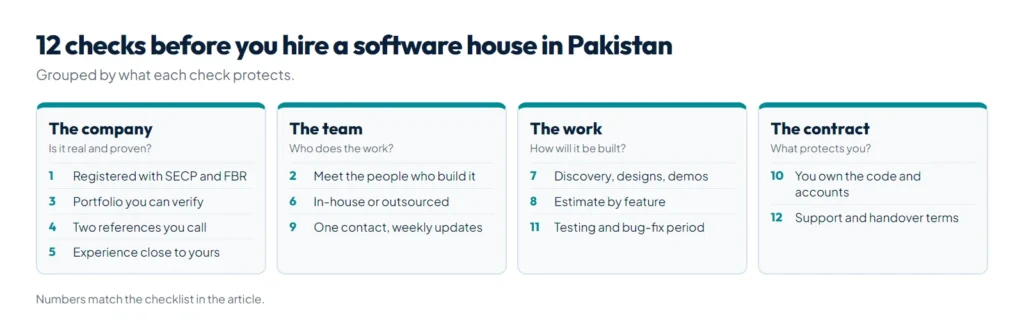
12 checks before you hire a software house in Pakistan
- Check that it is a registered business. Ask for the certificate of incorporation and the NTN. A private limited company is registered with the SECP, and certificates issued since 2021 carry a QR code to check the company’s registration status. Check the NTN and Active Taxpayer status on the FBR online verification service or the Tax Asaan app. A sole proprietor can be genuine too, but should still have an NTN and issue proper invoices. Membership of P@SHA, the Pakistan IT industry association, is a plus but not a requirement.
- Meet the real team. Visit the office or hold a video call with the project manager and the lead developer who will work on your project, not only the salesperson. Check their profiles on LinkedIn.
- Verify the portfolio. Ask for live links and apps you can install, not only screenshots, and ask which parts they built. Templates and themes are fine, but you need to know what was custom.
- Call two references. Ask past clients whether the project finished on time and on budget, how changes were handled and whether the software house still supports them.
- Look for experience close to yours. A team that has built booking, inventory or accounting systems before will ask better questions about yours. Ask for one similar project and what they would do differently now.
- Ask who builds it. Find out whether the work stays in-house or goes to freelancers or another company, and who replaces a developer who leaves.
- Understand the process. A good software house starts with a short discovery phase, shows screen designs before building, demos working software every one or two weeks on a test site, and tests before each release.
- Get a feature-by-feature estimate. One total price after one phone call is a guess. Our guide to custom software development cost shows what a proper estimate looks like and how to compare two quotes.
- Agree how you will communicate: one named contact, response times, working hours, a weekly update and a shared task board, not only a WhatsApp group.
- Protect code ownership. The contract should say the code, designs and data belong to your business once paid. Keep the code repository, domain, hosting, cloud and app store accounts in your own name, with the software house added as a user.
- Agree testing and the bug-fix period. Ask who tests, on which phones and browsers, and how long bugs found after launch are fixed free of charge. Get it in writing.
- Plan support after launch. Ask for a monthly support or maintenance price, what it covers, how fast urgent problems are answered and how you get everything back if you move to another company.
Questions to ask in the first meeting
- Which of your projects is closest to ours, and can we speak to that client?
- Who will work on our project, and how much of their time will it get?
- How will you find out exactly what we need before you give a final price?
- How often will we see working software, and where?
- What happens to the price and the timeline when we change something?
- Where will the code live, and when do we get access to it?
- What does support cost after launch, and what does it cover?
Red flags
- A firm price after one call, with no feature list.
- Asking for all or most of the money upfront.
- Refusing to put the code in your repository, or keeping your domain, hosting or app store account in their name.
- No written contract, or a one-page quote with no scope.
- A portfolio of screenshots with no client you can call.
- You never get to speak to a developer.
- Promises of unlimited changes for a fixed price, which usually end in arguments later.
How do software houses in Pakistan charge?
Most estimate the hours each feature needs and multiply by a rate, then charge in one of three ways:
| Model | How it works | Best when |
|---|---|---|
| Fixed price | One price for an agreed scope, often per phase | The scope is clear and will not change much |
| Time and materials | You pay for the hours actually worked | You expect to learn and change as you go |
| Dedicated developer or team | A monthly fee for people who work only on your product | Long-running products with a steady list of work |
Whichever model you choose, tie payments to milestones you can see and test, such as approved designs, a working test version and launch.
What should the contract include?
- The scope, as a feature list with the screen designs attached.
- Milestones, dates and the payment for each.
- How you will check and accept each milestone.
- How changes are requested, priced and approved.
- Ownership of the code, designs and data, passing to you on payment.
- Confidentiality, covering your business data and customer records.
- The bug-fix period after launch and the support terms after it.
- What happens if either side ends the contract, including the handover of code, documents and logins.
For a website rather than a software system, our guide on how to choose a website developer covers the same ground with website-specific questions.
Summary
Choosing a software house in Pakistan comes down to proof: proof that the company is registered with the SECP and the FBR, proof of real work through live projects and references, a meeting with the people who will build your software, a feature-by-feature estimate, and a contract that gives you the code, the accounts and a clear support plan. If you are planning a business system, our custom software development team is happy to go through this checklist with you.
References
- SECP eServices company name search, Securities and Exchange Commission of Pakistan
- Online Verification Services, Federal Board of Revenue
- P@SHA, the Pakistan IT industry association