
On this page
- Freelancer, agency or website builder?
- Questions about their work
- Questions about your project
- Questions about ownership and support
- How do you check a developer’s work yourself in 15 minutes?
- How do you score developers side by side?
- What are the red flags?
- What should you own when the site is handed over?
- Hiring from the UAE, Saudi Arabia, the UK or the US?
- What does a good website proposal look like?
- How do you compare website quotes fairly?
- Summary
- References
Choose a website developer by checking three things: live proof that they have built sites like yours, a written scope and price you fully understand, and clear answers about ownership, timelines and support after launch. Ask the 15 questions below before you pay anything, and compare every quote against the same scope, so you are comparing prices for the same job.
Many website problems start at the hiring stage: a vague scope, a domain registered in the developer’s name, or no plan for support. The questions are grouped into three parts: their work, your project, and ownership and support.
Freelancer, agency or website builder?
| Freelancer or small studio | Agency | DIY website builder | |
|---|---|---|---|
| Cost | Lower to mid | Mid to high | Lowest upfront, monthly fees |
| Who you talk to | The person building it | An account manager | Help articles and support chat |
| Best for | Small and medium business sites | Large projects with many people involved | Very simple sites you build yourself |
| Main risk | One person’s availability | Overheads and slower changes | Your time, limits and a generic result |
Questions about their work
- Can I see three live websites you built that are similar to mine? Visit them on your phone. Ask if you can speak to one of those clients.
- Who will actually build my site? You or someone you pass the work to?
- How do you make sites fast and mobile-friendly? Ask for the PageSpeed Insights result of a recent site.
- Do you build with a page builder, the block editor or custom code, and why? Our comparison of Elementor, Gutenberg and custom themes explains the trade-offs.
- What SEO do you set up at launch? At minimum: page titles and descriptions, a sitemap, Google Search Console and clean URLs.
Questions about your project
- Exactly which pages, features and revision rounds are included?
- Who writes the text and supplies the photos?
- What is the total cost, including yearly licences, hosting and anything billed later?
- What is the timeline, and what do you need from me, and by when, to meet it?
- How and when do I pay? A deposit and milestones, or after approval?
- Will the design be original? If you are matching a site you like, read is it legal to copy a website design first.
Questions about ownership and support
- Will the domain, hosting and WordPress admin be in my name?
- Do I own the code and design files once I have paid?
- What support do I get after launch, for how long, and what do changes cost afterwards?
- Who handles backups, security updates and emergencies, and how fast do you respond? A WordPress backup and security plugin such as our WP Toolkit Studio covers both, but someone still has to check it.
How do you check a developer’s work yourself in 15 minutes?
You do not need to be technical to test a portfolio. Pick two of their live sites and do this:
- Run PageSpeed Insights on mobile. Paste each site’s address into PageSpeed Insights. If the top section shows real-visitor data, check that Largest Contentful Paint is 2.5 seconds or less, Interaction to Next Paint 200 milliseconds or less and Cumulative Layout Shift 0.1 or less. Our guide to WordPress speed optimization explains these numbers.
- Use the site on your phone. Open the menu, submit the contact form, tap the WhatsApp or call button. Broken basics on a portfolio site are a warning about yours.
- Search for the business on Google. Check that the page title and description in the results read well and are not the default “Just another WordPress site” or a theme name.
- Look at the footer and contact page. Is the copyright year current, do the social links work, is the address right? This shows whether the developer finishes the details.
- Ask how each site was built. A good developer explains why they chose a page builder, the block editor or custom code for that client. Our comparison of Elementor, Gutenberg and custom themes shows what each choice means for you.
How do you score developers side by side?
Score each developer from 1 to 5 on each line, multiply by the weight, and add up. The weights below reflect what causes the most trouble after launch; change them if your priorities differ.
| Criterion | Weight | What a 5 looks like |
|---|---|---|
| Similar live work | 3 | Three or more live sites like yours, a client you can call |
| Written scope | 3 | Every page, feature and exclusion listed in writing |
| Ownership and access | 3 | Domain, hosting and admin in your name, stated in the proposal |
| Total cost clarity | 2 | First-year and yearly costs listed, including licences |
| Speed and mobile quality | 2 | Portfolio sites pass Core Web Vitals on mobile |
| Support after launch | 2 | Written response times and a rate for changes |
| Communication | 1 | Clear, prompt replies during the quoting stage |
The maximum is 80. A developer who scores low on ownership should not win on price alone, because fixing ownership later can cost more than the website.
What are the red flags?
- No live portfolio, only screenshots or templates.
- A price far below others with a vague scope.
- Full payment demanded before any work is shown.
- The domain or hosting registered in the developer’s own account.
- No written scope or contract.
- Promises of a guaranteed first-page Google ranking. Google itself says no one can guarantee a number one ranking; our guide to SEO cost in Pakistan covers this.
What should you own when the site is handed over?
Use this as a handover checklist. Ask for each item in writing before the final payment.
| Item | What “you own it” means |
|---|---|
| Domain name | You are the registrant, the contact email is yours, and you can log in to the registrar account. ICANN states that the registrant assumes sole responsibility for the domain and must keep its contact details accurate. |
| Hosting | The hosting account and its billing are in your name; the developer has their own login or a temporary one. |
| WordPress admin | You have your own Administrator account. WordPress defines an Administrator as someone with access to all administration features of the site. The developer can keep a separate account while they support you. |
| Theme and code | You receive the theme files. WordPress is licensed under the GPL, and WordPress.org considers themes and plugins derivative works that inherit it; confirm in the contract that you may use, change and move the code. |
| Paid plugin licences | Bought in your name or transferred to you, so renewals and updates do not depend on the developer. |
| Google accounts | Search Console, Analytics and Google Business Profile list you as owner, with the developer added as a user. |
| Backups and files | A full backup at launch, plus the logo, design files and photos you paid for. |
If your domain is a .pk domain
Moving a .pk domain out of a developer’s PKNIC account is slower than for a .com. PKNIC’s change-registrar rules require written authorisation from the company head on signed and stamped letterhead, or an affidavit from an individual owner, with a copy of the signatory’s CNIC. Scanned letters are not accepted: originals go by post to PKNIC in Lahore, and the domain can only be transferred if it has not expired. It is far easier to have it registered under your own account from day one.
Hiring from the UAE, Saudi Arabia, the UK or the US?
Many businesses abroad hire developers in Pakistan, and it works well when a few things are agreed at the start:
- Working hours overlap: Pakistan is one hour ahead of the UAE and two ahead of Saudi Arabia, so Gulf clients share almost a full working day. With the UK and US, agree a fixed daily window for calls and messages.
- One written channel: keep decisions in email or a shared document, not only in voice notes, so the scope stays clear.
- Milestone payments: pay against delivered stages, such as design approval, a working staging site and launch, rather than all upfront.
- A staging link: ask to see progress on a private staging site you can open at any time, not only screenshots.
If the same developer will handle your SEO, Google’s own advice is to ask for examples of past work, whether they follow Google Search Essentials, what results they expect and in what timeframe, and whether they will share every change they make to your site.
What does a good website proposal look like?
A proposal you can hold a developer to fits on two or three pages and covers:
- Scope: every page by name, the features on each, and what is not included.
- Content: who provides text, photos and translations, and by when.
- Design: how many design concepts and revision rounds, and how you approve them.
- Price: the total, the payment schedule, and every yearly cost after launch.
- Timeline: milestones with dates, and what happens if either side is late.
- Handover: admin access, training, and ownership of the domain, hosting, code and files.
- Support: what is included after launch, for how long, and the rate for changes.
How do you compare website quotes fairly?
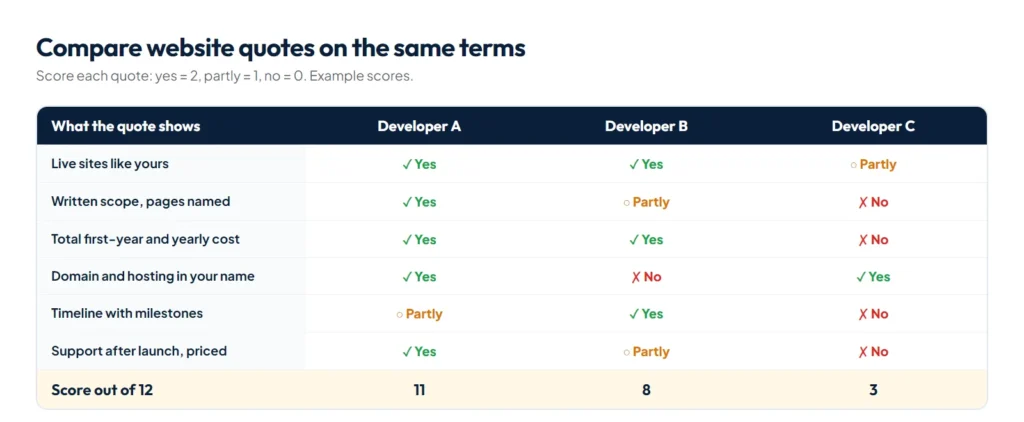
Put every quote into the same table: pages and features, content, design approach, total first-year cost, yearly running costs, timeline, payment terms, ownership and support. Score each one, and ask the cheaper developers to fill any gaps before you decide. Our guide to the website price in Pakistan shows typical ranges, so you can spot quotes that are unrealistically low or high.
Summary
To choose a website developer, ask for live proof, a written scope and clear answers on ownership and support, and compare every quote on the same terms. Keep the domain and hosting in your name and pay against finished work. If you want to put us through the same 15 questions, see our website development service and portfolio, and ask us anything on a free call.
References
- Change domain registrar (or account ID), PKNIC
- WordPress license, WordPress.org
- Roles and capabilities, WordPress.org documentation
- Do you need an SEO?, Google Search Central