
On this page
- What does copyright protect on a website?
- Is it legal to copy a website design in Pakistan?
- Is it legal to clone a website with a cloning tool?
- Can I use a WordPress theme or template that looks like another site?
- How to use a reference website the right way
- Safe to borrow vs not yours to take
- What to do if someone copies your website
- Summary
Is it legal to copy a website design? Copying the layout, structure and general style of a website is usually legal, because copyright protects creative expression, not ideas, systems or methods. Copying its text, photos, logo or code, or a look so close that customers could mistake you for that business, is not. The safe way to use a website you like is as a reference: borrow the layout and the features, then build it with your own content, licensed images and fresh code.
Clients often send us a website they like as a starting point, and it is the basis of our 24-hour WordPress offer, so we answer this question a lot. Here is where the line is, in plain language, with sources. This is general information, not legal advice; for a specific dispute, speak to an intellectual property lawyer.
What does copyright protect on a website?
The US Copyright Office puts it simply: “The original authorship appearing on a website may be protected by copyright. This includes writings, artwork, photographs, and other forms of authorship.” On the other side, “Copyright does not protect ideas, concepts, systems, or methods of doing something”, nor “names, titles, slogans, or short phrases” (US Copyright Office FAQ). Applied to a website, it looks like this:
| Part of a website | Protected? | What it means for you |
|---|---|---|
| Text: page copy, blog posts, product descriptions | Yes | Write your own. Rewording a page sentence by sentence can still count as copying. |
| Photos, illustrations, videos, custom icons | Yes | Use your own or licensed images. Credit is not permission. |
| Logo and brand name | Yes, as trademarks | Trademark law stops others using a confusingly similar brand. |
| Source code: HTML, CSS, JavaScript, theme files | Yes | Code is protected as a literary work. Write it fresh or use licensed code. |
| Layout and order of sections | Generally no | A hero, three service blocks and a contact form is an idea, not expression. |
| Colour scheme and choice of fonts | Generally no | But font files and icon sets come with their own licences. |
| Features: booking forms, filters, calculators | No, as ideas | Anyone can build a booking form. Patents on website features are rare. |
| The distinctive overall look of a well-known brand | Sometimes | In some countries a look that identifies a brand is protected as trade dress or under passing-off law. |
Is it legal to copy a website design in Pakistan?
The same principles apply. Copyright in Pakistan is governed by the Copyright Ordinance, 1962. Protection is automatic when a work is created, registration is optional but useful as evidence, and computer programs have been protected as literary works since a 1992 amendment (Chambers Trade Marks & Copyright guide: Pakistan). Pakistan has also been a member of the Berne Convention since 1948 (WIPO), so a website created in the US, UK or UAE is protected in Pakistan, and a Pakistani website is protected abroad.
In practice, a Pakistani business that copies a foreign competitor’s text or photos is exposed, and so is a foreign business that copies yours.
Is it legal to clone a website with a cloning tool?
Usually not, if you publish the result. Website cloners and “save page” tools copy the HTML, CSS, scripts, images and text, which are exactly the protected parts. Publishing a clone also causes practical problems:
- The owner can send a takedown notice to your hosting company, and hosts often remove the content first and ask questions later.
- Google tends to show the original and filter out copies, so a cloned site rarely ranks.
- A clone of a real brand, especially its login or checkout pages, looks like phishing and can get your domain flagged by browsers.
- Cloned code often carries the original site’s tracking codes, broken links and outdated scripts.
Copying a site privately to study how it was built is treated differently in many countries’ laws. If you do it, keep it offline and do not reuse the code or assets.
Can I use a WordPress theme or template that looks like another site?
Yes, if you have a licence for it. WordPress itself is free software released under the GPL, and themes in the official WordPress.org directory must be GPL-compatible. Premium themes come with a licence, and many license their demo images and design files separately from the code, so the demo photos are often not yours to publish. Avoid “nulled” themes and plugins from unofficial download sites: they are unlicensed copies and frequently contain malware or hidden links.
How to use a reference website the right way
- Pick two or three reference sites and note what you actually like: the layout, the way services are presented, the tone, a particular feature.
- Write your own content. Your services, prices, process and proof differ from theirs anyway, and original content is what ranks.
- Use your own photos or properly licensed stock images.
- Keep your own brand: your logo, colours and name. Do not reproduce their logo, slogan or distinctive graphics.
- Build the code fresh in your theme or page builder instead of copying their HTML and CSS.
- Do the confusion test: would a customer who knows the other business think your site belongs to them? If yes, change more.
This is how our 24-hour WordPress website works. You send a link to a site you like, we match its layout, structure and feel, and we build it with your content and your brand. The result is original and safe to publish, and you pay only after you approve it. For larger or fully custom builds, see our website development service.
Safe to borrow vs not yours to take
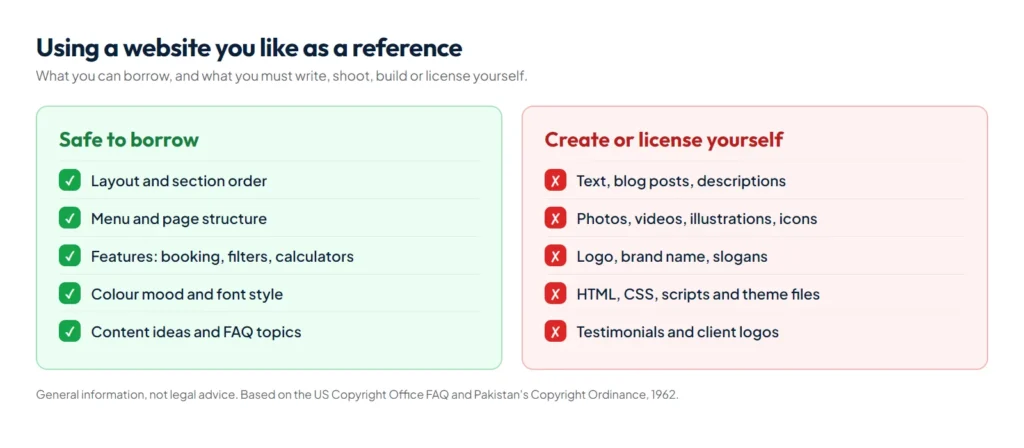
Safe to borrow
- The layout, section order, page types and menu structure.
- Features such as a WhatsApp button, booking form, filters or price calculator.
- A general colour mood and font style.
- Content ideas: the topics covered, the questions in the FAQ, how a pricing table is organised.
- Common good practice, such as a sticky header or trust badges near the contact form.
Not yours to take
- Text, photos, videos, illustrations and custom icons.
- The logo, brand name, slogans and distinctive graphics.
- Source code, scripts and theme files you have no licence for.
- Client logos, testimonials, case studies and awards, which are claims about that company.
- A copy so close to a well-known brand’s look that customers could be confused.
What to do if someone copies your website
- Collect evidence: dated screenshots, the copied URLs, and an archived copy of your own page from the Wayback Machine showing that yours came first.
- Contact the site owner and ask for removal. Many copies are made by a careless freelancer and come down quickly.
- Send a takedown notice to their host. For US-based hosts, use the DMCA process; most hosts publish an abuse or copyright contact.
- Ask Google to remove the copy from search results through its legal removal request form.
- Talk to a lawyer if the copying is commercial and continues. In Pakistan, copyright and trademarks registered with IPO-Pakistan make enforcement easier.
Summary
Is it legal to copy a website design? The layout, structure and features, generally yes. The words, images, logo, code and a confusingly similar brand look, no. Use websites you admire as references, then build with your own content, licensed assets and fresh code. That gives you a site you are free to publish and one with a real chance of ranking. To see what a reference-based build costs, read our guide to the website price in Pakistan, or browse our portfolio of client websites.