
On this page
- What is custom software development?
- What drives the cost of custom software?
- How do developers estimate a project?
- Worked example: a booking and quotes system for a service business
- How accurate is an early estimate?
- Fixed price or time and materials?
- What should a good quote include?
- What do Pakistani businesses need to plan for?
- How can you reduce the cost without cutting quality?
- What does custom software cost after launch?
- Worked example: what does the system cost over three years?
- When is custom software worth it?
- Summary
- References
Custom software development cost is mostly people’s time: the hours needed to design, build, test and launch each feature, multiplied by the team’s rate, plus hosting and ongoing maintenance. A small internal tool can take a few weeks; a multi-user system with integrations, reports and mobile access can take several months. The most reliable way to get an accurate price is to break the project into features, estimate each one as a range, and build the smallest useful version first.
We build custom software for small and medium businesses, including our own travel agency system, Safar Studio, so the method below is the one we use to quote. It also shows you how to read someone else’s estimate.
What is custom software development?
Custom software development means designing and building software for one business’s own way of working, instead of buying a ready-made product and adapting to it. The business usually owns the code and decides what is built next. It covers internal tools, customer portals, booking and quoting systems, point of sale and inventory systems (see our guide to POS software in Pakistan), and the integrations that make existing apps share data. The alternative is off-the-shelf software, such as a CRM or accounting package, which is faster to start but fits everyone the same way. Our custom software development service covers both new systems and connecting the tools you already use.
What drives the cost of custom software?
- Features and screens: every form, list, report and setting is time.
- Users and permissions: different roles that see and do different things.
- Integrations: payment gateways, WhatsApp, accounting software, email, government or partner systems.
- Data migration: moving years of records out of spreadsheets or an old system.
- Platforms: web only, or also mobile apps or a desktop app that works offline.
- Security and reliability: backups, audit logs, encryption and uptime needs.
- Design polish and the amount of testing.
How do developers estimate a project?
- Discovery: understand the business process, the users and what success looks like.
- Feature list: write each feature as something a user needs to do.
- Estimate each feature as a range, low and high, in hours.
- Add the work around the features: design, testing, project management, deployment and training.
- Add contingency for the unknowns, and show the total as a range.
- Split it into phases, with the first phase delivering something useful on its own.
Worked example: a booking and quotes system for a service business
Here is a feature-by-feature estimate for a typical small business system: staff log in, manage customers, take bookings, send quotes and invoices, and see a simple dashboard. The hours are an example estimate for illustration.
| Feature | Estimated hours |
|---|---|
| Discovery and wireframes | 16 to 24 |
| User accounts, roles and login | 16 to 24 |
| Customer records and search | 16 to 24 |
| Bookings and calendar | 24 to 40 |
| Quotes and invoices with PDF | 24 to 40 |
| WhatsApp and email notifications | 12 to 20 |
| Reports dashboard | 16 to 24 |
| Settings and admin | 8 to 12 |
| Testing and fixes | 24 to 40 |
| Deployment, training and documentation | 8 to 16 |
| Total | 164 to 264 hours |
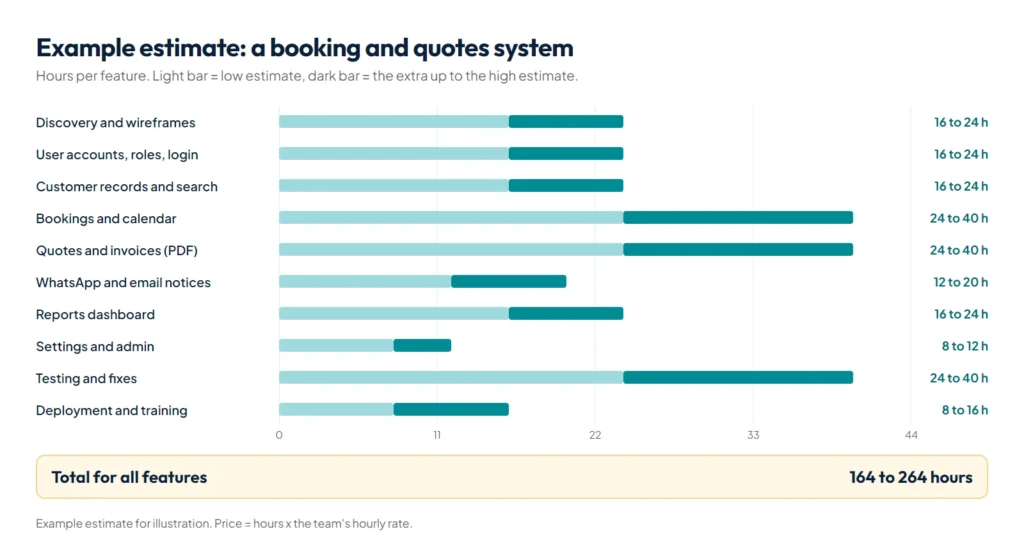
To turn hours into a price, multiply by the team’s hourly rate. At an example rate of PKR 3,000 an hour, which is an illustration and not a market average, this project would cost PKR 492,000 to 792,000. Notice that bookings, quotes and testing make up the largest share; cutting a feature saves far more than haggling over the rate.
How accurate is an early estimate?
Less accurate than most people expect, and that is normal. Steve McConnell’s Cone of Uncertainty, published by Construx, shows how far estimates by skilled estimators can be off at each stage of a project:
| Project stage | Estimate can be off by | For a 200-hour project |
|---|---|---|
| Initial idea | 0.25x to 4x | 50 to 800 hours |
| Agreed product definition | 0.5x to 2x | 100 to 400 hours |
| Requirements complete | 0.67x to 1.5x | 134 to 300 hours |
| Screen designs complete | 0.8x to 1.25x | 160 to 250 hours |
The paper also notes that most of the narrowing happens in the first 20 to 30 percent of the project’s calendar time, and only when decisions get made. In practice this means a price given after a single phone call is a guess. Pay for a short discovery phase that produces a feature list and screen sketches, and you get an estimate worth comparing. Be wary of a quote that is a single precise number for a project nobody has scoped yet.
Fixed price or time and materials?
| Fixed price | Time and materials | |
|---|---|---|
| Best when | The scope is clear and stable | The scope will change as you learn |
| Your risk | Low on budget, but changes cost extra | Budget can grow if scope grows |
| Flexibility | Low | High |
| Middle ground | A fixed price for each phase | The next phase quoted after the first is delivered |
What should a good quote include?
Use this checklist to compare quotes on the same terms. A quote missing several of these is cheaper on paper, not in reality.
- A feature list with hours or a price for each feature, not one total.
- What is excluded, for example data migration, mobile apps, content entry or third-party fees.
- Testing, including who tests and on which devices and browsers.
- Integrations named one by one, with who pays for each service’s own fees.
- Milestones and payments tied to working features you can try, not to dates.
- Ownership: you own the code, designs and data, and receive the code repository, documentation and all logins.
- A warranty period for fixing bugs after launch, and the rate for changes after that.
- Hosting and maintenance priced separately, so you can see the running cost.
Getting the code is easy to arrange: GitHub’s free plan includes unlimited private repositories, so ask for the project to live in a repository your business owns, with the developer added as a collaborator. Our guide on how to choose a website developer lists more questions that apply equally to software teams.
What do Pakistani businesses need to plan for?
- Payment integrations take calendar time, not only build time. Card gateways and wallets such as JazzCash and Easypaisa need a merchant account approved by the provider before developers can test live payments, so apply early.
- WhatsApp notifications need the WhatsApp Business API with a verified business and approved message templates, and Meta charges per delivered template message.
- Offline use and power cuts: if staff work in areas with unreliable internet, say so up front. A system that keeps working offline and syncs later costs more to build than a web-only one.
- Dollar-priced running costs: cloud hosting and many third-party services bill in US dollars, so budget for exchange-rate changes.
- Urdu and right-to-left text on screens, PDFs and SMS adds design and testing time if you need it.
How can you reduce the cost without cutting quality?
- Start with the smallest useful version and add features once people use it.
- Buy what is standard, build what is unique: use existing payment gateways, email services and accounting software instead of rebuilding them.
- Write down the process before development starts; unclear requirements are the biggest cause of overruns.
- Have one decision-maker who can answer questions quickly.
- Release in phases, so feedback shapes the next phase.
What does custom software cost after launch?
Plan for hosting, backups, security updates, bug fixes, support for users and new features as the business changes. Agree a maintenance arrangement before launch and budget for it every year, so the system keeps working as browsers, phones and the services it connects to change.
Worked example: what does the system cost over three years?
The build is only part of the cost. Taking the booking and quotes system from the example above, here is a three-year view. The assumptions are illustrative, not quotes:
- Build: PKR 492,000 to 792,000, from the example estimate.
- Hosting: a 4 GB DigitalOcean Droplet at $24 a month, about $288 a year. At an assumed rate of PKR 280 to the US dollar, that is about PKR 80,640 a year.
- Maintenance and small changes: an assumed 6 hours a month at the example rate of PKR 3,000, which is PKR 216,000 a year.
| Cost | Year 1 | Years 2 and 3 | Three-year total |
|---|---|---|---|
| Build | PKR 492,000 to 792,000 | None | PKR 492,000 to 792,000 |
| Hosting | PKR 80,640 | PKR 161,280 | PKR 241,920 |
| Maintenance | PKR 216,000 | PKR 432,000 | PKR 648,000 |
| Total | PKR 788,640 to 1,088,640 | PKR 593,280 | PKR 1,381,920 to 1,681,920 |
Compare that with a subscription tool for the same team. If 15 staff used Zoho CRM Professional at $23 per user a month billed annually, that is $4,140 a year, or about PKR 1,159,200 at the same assumed exchange rate, and about PKR 3,477,600 over three years. A subscription still has advantages: no build risk, vendor updates and support. But once a team is large or the off-the-shelf tool needs heavy workarounds, the three-year numbers often favour building. Run the same sum with your own user count and quotes; our guide to choosing a CRM for a small business has current CRM prices to plug in.
When is custom software worth it?
When off-the-shelf tools do not fit how you work, per-user fees keep growing, you need your systems to talk to each other, or you need to own your data and code. We built Safar Studio for travel and Umrah agencies for exactly those reasons: general tools did not handle groups, passports and supplier accounts, and agencies needed it to work offline. If you are deciding between a CRM and a custom system, our guide to choosing a CRM for a small business helps you compare.
Summary
Custom software development cost comes down to hours times rate, plus what it takes to run the system afterwards. Ask for estimates broken down by feature, compare them line by line, build the smallest useful version first, and put code ownership in the contract. For a feature-by-feature estimate of your project, see our custom software development service; to automate before you build, read our guide to AI automation for small businesses.
References
- Software Development’s Cone of Uncertainty, Steve McConnell, Construx
- Droplet pricing, DigitalOcean
- GitHub pricing, GitHub
- Zoho CRM edition pricing, Zoho