
On this page
- What features should POS software have in Pakistan?
- Who must integrate POS with FBR?
- What does an FBR-integrated POS have to do?
- What is the POS service fee and how do customers verify invoices?
- What happens if a Tier-1 retailer does not integrate?
- Do provinces have their own POS systems?
- Cloud or desktop POS?
- Ready-made or custom POS software?
- What does POS software cost in Pakistan?
- Questions to ask a POS vendor
- Summary
- References
Good POS software in Pakistan does four jobs: fast billing with a barcode scanner, live stock across every counter and branch, receipts your customers can read, and, for Tier-1 retailers, real-time reporting of every sale to FBR with an FBR invoice number and QR code on the receipt. If your shop is a Tier-1 retailer, FBR integration is not optional: the Sales Tax Act sets penalties from Rs 500,000 for a first default, and the law reduces your input tax by 60% for any period you are not integrated. This guide explains the features that matter, who has to integrate, what an integrated POS must do, and how to choose between ready-made and custom software.
We build custom business software in Pakistan, including our own desktop system for travel agencies, Safar Studio, which has a quick-cash POS counter and 80mm thermal receipts. The FBR rules below are taken directly from the Sales Tax Act, 1990 as amended to 30 June 2026, Chapter XIV of the Sales Tax Rules, 2006, and FBR’s own POS pages.
What features should POS software have in Pakistan?
Start with the counter. A cashier in a busy shop needs speed and few clicks. Then look at what the owner needs to see at the end of the day.
- Barcode scanning and label printing: scan to add items, and print barcodes for products that arrive without one.
- Stock that updates on every sale: low-stock alerts, purchase entries, stock transfers and stock counts.
- Multi-branch: each branch sells on its own, while the owner sees combined sales and stock.
- Offline mode: the counter keeps billing when the internet drops, and syncs later.
- Urdu and English receipts: section 23 of the Sales Tax Act allows invoice particulars in Urdu or English, and many customers prefer Urdu item names.
- Thermal and A4 printing: 80mm receipts at the counter, A4 invoices for business buyers. For an occasional A4 invoice without a POS, our free invoice generator for Pakistan makes one with NTN, STRN and sales tax.
- Returns, exchanges and credit notes: recorded against the original invoice, not as a negative sale.
- Card, QR and wallet payments alongside cash, with a daily cash-up per cashier.
- Staff roles: discounts, voids and refunds need a manager PIN, with a log of who did what.
- Reports: daily sales, profit by item, slow movers, sales by cashier and by branch.
- Backups and data export: automatic backups and a full export to Excel.
Who must integrate POS with FBR?
Tier-1 retailers. Section 2(43A) of the Sales Tax Act, 1990 defines a Tier-1 retailer as one that falls in any of these categories:
| Category | Test in the law |
|---|---|
| Chain store | A unit of a national or international chain of stores |
| Air-conditioned mall | A retailer in an air-conditioned shopping mall, plaza or center, excluding kiosks |
| Electricity bill | Cumulative electricity bill over the last 12 months above Rs 1.2 million |
| Wholesaler-cum-retailer | Turnover above Rs 200 million, in bulk import and supply to retailers and to the public |
| Turnover | Retail turnover above Rs 200 million in the last 12 months |
| Notified by FBR | Any other person or class the Board prescribes |
Section 23(6) says all Tier-1 retailers shall integrate their retail outlets with FBR’s computerized system for real-time reporting of sales. Rule 150R(3) of the Sales Tax Rules adds that an integrated person may only make sales through integrated outlets or points of sale. If you are close to any threshold, plan for integration before you buy software, not after.
What does an FBR-integrated POS have to do?
Rule 150R(4) of Chapter XIV of the Sales Tax Rules, 2006 lists the functions every integrated POS or e-invoicing machine must perform:
- Generate, receive, record, analyze and store invoice data.
- Issue sales tax invoices in the prescribed format, with a digital signature.
- Send each invoice to FBR’s computerized system and receive a unique FBR invoice number.
- Encrypt and preserve the reported invoice data so it cannot be altered.
- Generate a QR code from the FBR invoice number and print it on the receipt.
- Perform day, week and month closing.
- Log every adjustment, modification and cancellation, plus system events.
The same chapter adds requirements that affect your choice of software and hardware:
- Offline invoices: invoices made during an internet or power failure must be marked as offline and uploaded within 24 hours of restoration (rule 150XC). Offline mode is therefore a legal need, not just a convenience.
- Receipt contents: the e-invoice carries the FBR invoice number, a 7 x 7 mm QR code, the POS software registration number and FBR’s digital invoicing logo, among other particulars.
- Signboard: each integrated outlet displays an “Integrated with FBR” sign with the software’s registration number.
- Card and QR payments, and CCTV: FBR may require card machines or QR payment at every sale point, and CCTV recording of each point of sale kept for at least one month.
- Online sales: websites and apps used for online sales must also be registered with FBR’s system.
- Who integrates: integration is done through a licensed integrator. PRAL acts as a licensed integrator and, under rule 150XF, provides integration free of cost on demand.
What is the POS service fee and how do customers verify invoices?
FBR’s SRO 1279(I)/2021 levies a service charge of one rupee per invoice issued through POS terminals integrated with FBR. Tier-1 retailers collect it and deposit it with their monthly sales tax payment and return. It is Re 1 per invoice, whatever the invoice value, not 1% of the bill. FBR’s POS legal provisions page still lists this SRO.
Customers can check any integrated receipt. FBR’s POS invoice verification page says to open the FBR POS menu in the Tax Asaan app and tap Verify Invoice, then enter the FBR invoice number or scan the QR code. Customers can also SMS INV, their CNIC number and the FBR invoice number to 9966. The app shows the invoice as verified or unverified.
The prize scheme has changed since the monthly draws of 2022. Under Chapter XIV-AC of the Sales Tax Rules, as amended in 2024, prizes go to customers who report an unverified invoice from an integrated Tier-1 retailer. The report needs the customer’s CNIC, mobile number, IBAN, a picture of the invoice, a GPS-tagged picture of the shop and proof of digital payment; without proof of digital payment the prize claim is forfeited. For a retailer, every sale that does not reach FBR is now a risk that a customer can report.
What happens if a Tier-1 retailer does not integrate?
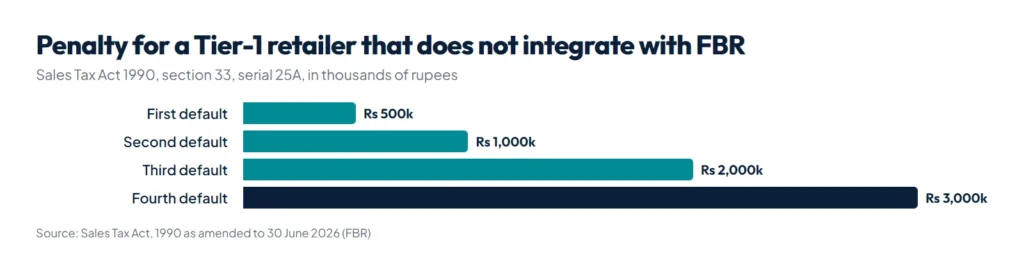
Serial 25A of section 33 sets penalties for a person required to integrate under section 23 who fails to register, fails to integrate or fails to issue electronic invoices after integration:
| Default | Penalty |
|---|---|
| First | Rs 500,000 |
| Second, 15 days after the first order | Rs 1,000,000 |
| Third, 15 days after the second order | Rs 2,000,000 |
| Fourth, 15 days after the third order | Rs 3,000,000 |
The business premises can also be sealed. The first penalty is waived if the retailer integrates before the second penalty is imposed. Separately, section 8(6) reduces the adjustable input tax for the whole tax period by 60% if a Tier-1 retailer has not integrated, and section 14AB lets FBR direct gas and electricity companies to disconnect notified Tier-1 retailers that are registered but not integrated.
Do provinces have their own POS systems?
Yes, for services. The Sindh Revenue Board runs SRB-POS, an e-invoicing system for hospitality, health and beauty businesses that it says carries zero cost and works with common POS solutions, with its own invoice verification and lucky draw. The Punjab Revenue Authority runs an electronic invoice monitoring system (eIMS) with an online invoice lookup. A restaurant or salon may therefore need to connect to a provincial system as well as, or instead of, FBR. Check with the authority in your province before you choose software.
Cloud or desktop POS?
| Desktop (installed on the counter PC) | Cloud (runs in a browser) | |
|---|---|---|
| Internet outage | Keeps billing; uploads to FBR when back | Needs an offline mode; ask exactly how it works |
| Multi-branch view | Needs sync or a central server | Built in |
| Speed at a busy counter | Fast, no page loads | Depends on the connection |
| Data location | Your PC or server, your backups | Vendor’s servers |
| Typical pricing | One-time or yearly license | Monthly subscription |
For a single shop with unreliable internet, desktop software with sync is usually safer. For a chain that wants one dashboard, cloud or a hybrid that bills locally and syncs to a central database works better. Either way, the 24-hour upload rule means offline invoices must reach FBR soon after the connection returns.
Ready-made or custom POS software?
| Ready-made POS | Custom POS | |
|---|---|---|
| Start time | Days | Weeks to months |
| Fit | Standard retail flow | Your exact flow: weighing scales, made-to-order, wholesale price lists, installment sales |
| FBR integration | Check the vendor integrates through a licensed integrator | Built against FBR’s technical documentation and configured by a licensed integrator |
| Integrations | What the vendor offers | Your accounting software, website, WhatsApp or ERP |
| Ownership | License or subscription | You usually own the code |
Ready-made is the right choice for most single shops. Custom makes sense when your process does not fit a standard POS, when you need POS, stock, online store and accounts to share one database, or when per-user subscription fees across many branches add up. Our custom software development service builds POS and inventory systems around the way a business already works.
What does POS software cost in Pakistan?
Only a few cost items are fixed by the rules:
- FBR integration through PRAL: free of cost on demand (rule 150XF).
- Licensed integrators: may charge for configuration and integration, but not above a ceiling FBR sets by sales tax general order (rule 150XO).
- Equipment and software: the cost of hardware and POS software is borne by the retailer (rule 150R(10)).
- Service charge: Re 1 per invoice, collected from the customer and deposited with your return.
Software prices vary by vendor, number of counters and branches, and support level, so ask every vendor for a written quote that separates license, setup, integration, hardware and yearly support. For a custom system, our guide to custom software development cost shows how to estimate it feature by feature.
Questions to ask a POS vendor
- Is your FBR integration done through a licensed integrator, and what is your software registration number?
- What happens at the counter when the internet drops, and how are offline invoices uploaded?
- Can receipts print item names in Urdu?
- How do returns and credit notes work with FBR invoices?
- Can I export all my data, and who holds the backups?
- What will it cost per year after the first year, including support?
For what a compliant invoice must contain, see our guide to the sales tax invoice format in Pakistan. Retailers and online sellers can also see what we build on our ecommerce and retail page.
Summary
Choose POS software in Pakistan on four things: fast barcode billing, accurate multi-branch stock, receipts in Urdu or English, and a reliable offline mode. If you are a Tier-1 retailer, the POS must also send every sale to FBR in real time, print the FBR invoice number and QR code, upload offline invoices within 24 hours and collect the Re 1 service charge; penalties for not integrating start at Rs 500,000 and rise to Rs 3 million. Integration through PRAL is free, while licensed integrators charge within FBR’s limits. If no ready-made system fits your shop, our custom software development team can build one, and our cost guide explains how to budget for it.