
On this page
- What must a sales tax invoice show in Pakistan?
- What changed in 2025 and 2026?
- What is an FBR e-invoice, and who must issue one?
- Sales tax invoice vs commercial invoice
- NTN vs STRN: what is the difference?
- What about provincial sales tax on services?
- Example: a filled sales tax invoice
- How long must you keep sales tax invoices?
- Common mistakes that cause trouble
- Summary
- References
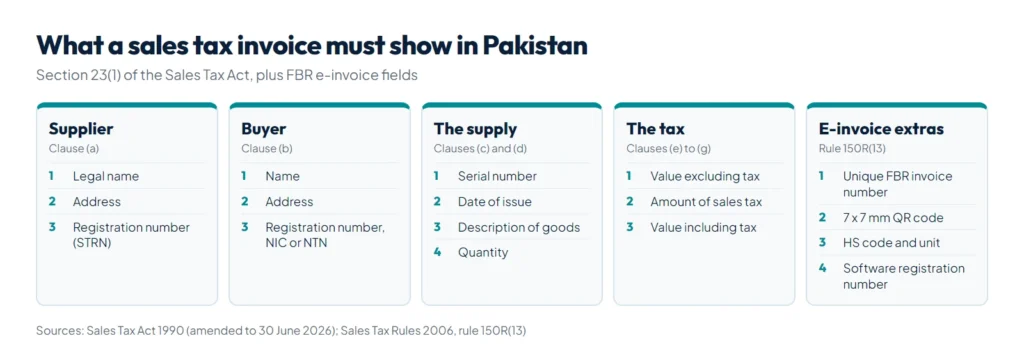
A sales tax invoice in Pakistan must show the particulars listed in section 23(1) of the Sales Tax Act, 1990: the supplier’s name, address and registration number; the buyer’s name, address and registration number; the date; a description and quantity of the goods; the value excluding tax; the amount of sales tax; and the value including tax. It must be serially numbered, issued at the time of supply, and may be in Urdu or English. Since the Finance Act, 2026, invoices are also required for exempt supplies and must carry a verifiable, unique FBR invoice number from the date FBR notifies.
We built and maintain a free invoice generator for Pakistan that prints NTN, STRN and sales tax lines, and we build invoicing and POS software for businesses here. The requirements below come from FBR’s consolidated Sales Tax Act (amended to 30 June 2026), Chapter XIV of the Sales Tax Rules, FBR’s digital invoicing FAQs, and the provincial laws published by the Punjab Revenue Authority and the Sindh Revenue Board.
What must a sales tax invoice show in Pakistan?
Section 23(1) of the Sales Tax Act, 1990 lists these particulars:
| Clause | Particular | Practical note |
|---|---|---|
| (a) | Name, address and registration number of the supplier | Your legal name and STRN as registered |
| (b) | Name, address and registration number of the recipient | For supplies by a manufacturer or importer to an unregistered distributor, the distributor’s NIC or NTN |
| (c) | Date of issue of invoice | Issue it at the time of supply |
| (d) | Description and quantity of goods | For textile yarn and fabric, include count, denier and construction |
| (e) | Value exclusive of tax | After any discount |
| (f) | Amount of sales tax | Shown separately |
| (g) | Value inclusive of tax | The amount the buyer pays |
The section also says the invoice is serially numbered, that not more than one tax invoice may be issued for a taxable supply, and that particulars may be in Urdu or English. Where goods are transported, the invoice must be linked with the e-Bilty generated under section 40C. Under section 23(2), only a registered person (or a person paying retail tax) may issue a tax invoice under this section.
What changed in 2025 and 2026?
- Exempt supplies (Finance Act, 2026): section 23(1) now requires a tax invoice for taxable as well as exempt supplies, including an advance receipt invoice.
- FBR invoice number (Finance Act, 2026): invoices must bear a verifiable and unique FBR invoice number, applicable from the time FBR notifies.
- e-Bilty link (Finance Act, 2025): transported goods need the tax invoice linked with the e-Bilty.
- Real-time reporting (Finance Act, 2025): sections 23(5) and 23(6) let FBR require any class of persons to integrate their invoicing system for real-time reporting, through a licensed integrator.
What is an FBR e-invoice, and who must issue one?
FBR’s digital invoicing FAQs say that under SRO 709(I)/2025, dated 22 April 2025, electronic invoicing is mandatory for all corporate and non-corporate sales tax registered persons. FBR later revised the schedule, so check its digital invoicing page for the date that applies to you. A few points from the FAQs:
- A scanned or copied paper invoice is not an electronic invoice.
- Integration is done through a licensed integrator. PRAL acts as one and integrates free of cost on demand.
- There is no FBR software to download; you integrate your own POS, ERP or invoicing system.
- Digital invoices are issued at the time of supply, and all sales reported in Annexure-C of the return need one.
Rule 150R(13) of Chapter XIV of the Sales Tax Rules, 2006 lists what an electronic invoice contains on top of the section 23 basics:
- Unique FBR invoice number, in the format XXXXXX-DDMMYYHHMMSS-0001
- A verifiable QR code, 7 x 7 mm
- The registration number of the invoicing or POS software, and the FBR digital invoicing logo
- Tax period, sales tax rate, HS code and unit of measurement
- Sales tax withheld at source, extra tax, further tax and federal excise duty in sales tax mode
- Total discount, invoice reference number, and the SRO and serial number that apply
A retailer issuing e-invoices to the general public can leave out extra tax, further tax, federal excise and the SRO reference, unless it is a manufacturer-cum-retailer or importer-cum-retailer.
Sales tax invoice vs commercial invoice
| Sales tax invoice | Commercial invoice | |
|---|---|---|
| Who issues it | Only a sales tax registered person | Any business |
| Legal basis | Section 23, Sales Tax Act | General business or trade document |
| Registration numbers | Supplier’s and buyer’s registration numbers | Optional |
| Tax shown | Value excluding tax, sales tax and value including tax, separately | Usually one total |
| Input tax | The buyer can use it to claim input tax, subject to the Act | Cannot support an input tax claim |
| FBR invoice number and QR | Required where e-invoicing applies | Not applicable |
If you are not registered for sales tax, issue a normal invoice with your business details and NTN, and do not show a sales tax amount you are not entitled to charge.
NTN vs STRN: what is the difference?
NTN is your National Tax Number for income tax. For an individual, the 13-digit CNIC is used as the NTN; companies and associations of persons get a separate number on e-enrollment with FBR. STRN is the registration number allocated when you register under the Sales Tax Act. Section 14 lists who must register, including manufacturers (other than cottage industry), importers, wholesalers, distributors, dealers, certain retailers, and, since 2025, sellers of digitally ordered goods. Section 23 asks for the registration number, so your STRN must appear; most businesses print their NTN as well, and for supplies by a manufacturer or importer to an unregistered distributor, clause (b) asks for the distributor’s NIC or NTN. If the buyer is not registered, section 3(1A) adds further tax at 4% of the value, unless an exemption applies.
What about provincial sales tax on services?
Services are taxed by the provinces, each with its own invoice rules. Two examples:
| Punjab (PRA) | Sindh (SRB) | |
|---|---|---|
| Law | Punjab Sales Tax on Services Act, 2012 | Sindh Sales Tax on Services Act, 2011 and Rules, 2011 |
| Standard rate | 16%, with other rates for some services in the Second Schedule | 15%, with other rates for some services in the Second Schedule |
| Invoice rule | Section 30: numbered and dated invoice | Rule 29: serially numbered invoice |
| Provider details | Name, address and registration number | Name, address and SNTN |
| Recipient details | Name, address and registration number, if any | Name, address and NTN, SNTN or CNIC |
| Amounts | Description, value excluding tax, tax, value including tax | Description, CPC code, value excluding tax, rate, tax, value including tax |
Sources: the Punjab Sales Tax on Services Act, 2012 published by PRA, and the Sindh Act and Rules on the SRB acts and rules page. In Sindh, customers on credit may receive one invoice at the end of each month. Khyber Pakhtunkhwa and Balochistan have their own revenue authorities and rules.
Example: a filled sales tax invoice
This example uses made-up businesses and placeholder registration numbers. It follows section 23(1) and applies the standard federal rate of 18% under section 3(1).
| Field | Example |
|---|---|
| Heading | SALES TAX INVOICE |
| Invoice number and date | STI-2026-0142, 3 November 2026 |
| Supplier | Example Textiles (Pvt) Ltd, Plot 12, Industrial Estate, Faisalabad |
| Supplier NTN and STRN | [supplier NTN], [supplier STRN] |
| Buyer | Example Home Stores (Pvt) Ltd, 45 Main Boulevard, Lahore |
| Buyer NTN and STRN | [buyer NTN], [buyer STRN] |
| No. | Description | Qty | Rate (Rs) | Value excl. tax (Rs) | Sales tax 18% (Rs) | Value incl. tax (Rs) |
|---|---|---|---|---|---|---|
| 1 | Cotton bedsheet, king size | 100 | 2,500 | 250,000 | 45,000 | 295,000 |
| 2 | Pillow cover, pair | 200 | 600 | 120,000 | 21,600 | 141,600 |
| Total | 370,000 | 66,600 | 436,600 |
If the buyer were not registered and no exemption applied, further tax of 4% on Rs 370,000, which is Rs 14,800, would be added, making Rs 451,400. Under e-invoicing, the same invoice would also carry the FBR invoice number, QR code, HS codes and the other rule 150R(13) fields, generated by your integrated system. To produce a clean PKR invoice with NTN and STRN quickly, use our free invoice generator, but note that its PDF is not an FBR e-invoice.
How long must you keep sales tax invoices?
Six years. Section 24 of the Sales Tax Act requires records and documents to be kept for six years after the end of the tax period they relate to, or longer while proceedings are pending. Rule 150S applies the same six years to electronic invoices, debit notes and credit notes, kept on electronic media.
Common mistakes that cause trouble
- No serial number, or numbers that skip or repeat
- Sales tax not shown separately from the value
- Buyer’s registration number missing or wrong
- Two invoices for the same supply
- Correcting a sale by editing the invoice instead of issuing a debit or credit note under section 9
- Charging sales tax while not registered
- Paper invoices where e-invoicing applies
If you run a tax or accounting practice, our tax and accounting firms page shows how we build service pages, secure document intake forms and client portals for firms like yours.
Retailers who must report sales to FBR in real time should read our guide to POS software and FBR integration in Pakistan. If you are just setting up, our guide on how to start an online business in Pakistan covers NTN and sales tax registration for online sellers.
Summary
A sales tax invoice in Pakistan follows section 23(1): supplier and buyer names, addresses and registration numbers, date, description and quantity, value excluding tax, sales tax and value including tax, serially numbered and issued at the time of supply. From 2026 it also covers exempt supplies and carries an FBR invoice number once notified, and registered persons under e-invoicing add the rule 150R(13) fields such as the QR code and HS code. Services follow provincial rules: 16% standard rate in Punjab and 15% in Sindh. Draft a clean invoice with our invoice generator for Pakistan, and if you advise clients on tax, see what we build for practices on our tax and accounting firms page.