
On this page
- Which online business model should you choose?
- Step 1: Register with FBR and get your NTN
- Step 2: Decide whether you need a company
- Step 3: Open a business bank account
- Step 4: Set up payments
- Step 5: Choose a courier and understand the deductions
- Step 6: Build your store
- Step 7: Market where your buyers already are
- Step 8: Keep records from the first order
- Checklist: your first month
- Summary
- References
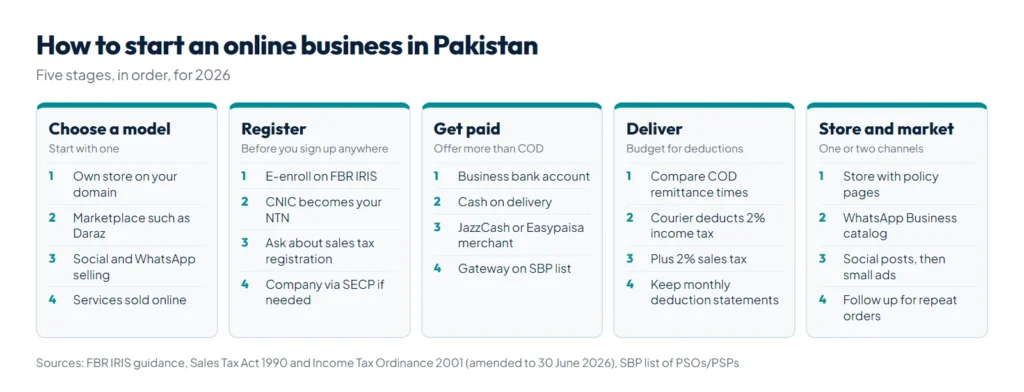
To start an online business in Pakistan in 2026, choose how you will sell (your own store, a marketplace such as Daraz, social media or services), register with FBR for an NTN, open a bank account in the business name, set up cash on delivery plus at least one digital payment method, pick a courier, and then put your marketing effort into one or two channels. Since the Finance Act, 2025, online sellers also have new tax duties: marketplaces and couriers must check that you are registered, and couriers and payment gateways deduct tax from your sales. This guide walks through each step in order, with the official rules and a worked example in rupees.
We build online stores and payment integrations for businesses in Pakistan, so most of what follows comes from setting up stores, gateways and courier flows in practice. The tax and registration rules are taken from FBR’s own published texts of the Sales Tax Act and the Income Tax Ordinance, linked below. We are not tax advisers, so confirm your own position with one before you file.
Which online business model should you choose?
There are four common ways to sell online in Pakistan. Most people start with one and add a second once orders come in.
| Model | How you sell | Main cost | Control over brand and data | Best for |
|---|---|---|---|---|
| Own online store | Your website with checkout | Build, hosting, marketing | Full | Repeat buyers, a brand you want to grow |
| Marketplace (Daraz and others) | Listings on the marketplace app | Commission on each order | Low: the marketplace owns the customer | Testing products, reaching buyers fast |
| Social selling | Facebook, Instagram, TikTok and WhatsApp orders | Ads and your time | Medium | Clothing, jewelry, food and handmade goods |
| Services | Online bookings, consulting, design, tutoring | Your time | Full | Skills you can sell without stock |
Daraz’s own seller page says it charges no listing fee and takes a commission that depends on the product category, deducted from your order payments. A marketplace is a cheap way to test demand, but it is not a substitute for your own store if you want buyers to come back to you.
Step 1: Register with FBR and get your NTN
For a sole proprietor, registration is online. According to FBR’s registration guidance, individuals e-enroll on the IRIS portal, and for an individual the 13-digit CNIC is used as the NTN. Before you start, keep these ready:
- CNIC number, a mobile number in use and an active email address
- Residential address and nationality
- Business name, business address and principal business activity
FBR’s guidance also says that for an association of persons or a company, the principal officer visits the Regional Tax Office to register. That is one reason many new sellers start as sole proprietors.
Why the NTN matters more for online sellers since 2025
The Finance Act, 2025 added e-commerce rules to both tax laws:
- Section 181 of the Income Tax Ordinance, 2001 now says an online marketplace or courier service shall not let any vendor use its services for e-commerce unless the vendor is registered.
- Section 14(1A) of the Sales Tax Act, 1990 requires people selling digitally ordered goods through a marketplace, website or app to apply for sales tax registration. Cottage industry and retailers who pay sales tax through their electricity bills are excluded.
- Section 14(1B) says marketplaces and couriers must not serve a seller without an NTN, or without sales tax registration where 14(1A) applies.
In practice: get your NTN before you sign up with Daraz or a courier, and ask a tax adviser whether you also need a sales tax registration number (STRN) for what you sell.
Step 2: Decide whether you need a company
You do not need a company to start. A sole proprietorship with an NTN is the simplest and cheapest route. A private limited company makes sense when you have partners or investors, want limited liability, or a payment partner or large buyer asks for one. SECP’s online eZfile corporate registry handles company registration and post-incorporation filings. Check SECP’s current fee schedule before you apply, because fees depend on the type of company and its capital.
If you sell services rather than goods, provincial sales tax on services may also apply, through the Punjab Revenue Authority, the Sindh Revenue Board or the authority in your province.
Step 3: Open a business bank account
Keep business money separate from day one. Payment gateways and marketplaces settle into a bank account, and gateways usually verify that the account title matches the business. A separate account also makes your records, and any tax deduction certificates, far easier to reconcile.
Step 4: Set up payments
Most Pakistani stores offer more than one way to pay:
- Cash on delivery (COD): still expected by many buyers, but you carry the risk of refused parcels and wait for the courier to remit cash.
- JazzCash and Easypaisa: mobile wallets that need a merchant account, not a personal wallet, to accept payments on a website.
- Cards and bank transfers through a gateway: the State Bank of Pakistan’s list of authorized payment system operators and providers (last updated 2 September 2026) shows e-commerce payment gateways such as Premier Payfast, Safepay and NIFT in commercial operation. Check that any gateway you sign with is on that list. Our comparison of payment gateways for Pakistani websites sets out each one’s payment methods and published fees.
Gateways usually ask for a live website on your own domain with HTTPS, clear refund, delivery and privacy pages, and business documents. Our guide to adding JazzCash and Easypaisa to WooCommerce covers the merchant review and the technical setup step by step.
Step 5: Choose a courier and understand the deductions
Compare couriers on COD remittance time, return charges, city coverage and whether they offer a booking portal or API that connects to your store. Then factor in the e-commerce tax deductions, which are now in the law:
| Deduction | Who deducts it | Rate | Legal source |
|---|---|---|---|
| Income tax on online payments | Payment intermediary (bank or gateway) | 1% of the gross amount | Section 6A and First Schedule, Income Tax Ordinance |
| Income tax on cash on delivery | Courier | 2% of the gross amount | Section 6A and First Schedule, Income Tax Ordinance |
| Sales tax on digitally ordered goods | Payment intermediary or courier | 2% of the gross value | Section 3(3)(c) and Eleventh Schedule, Sales Tax Act |
Worked example: what is deducted from a Rs 5,000 order
Here is how the rates above apply to one order of Rs 5,000, before the courier’s or gateway’s own service charges:
| Paid online | Cash on delivery | |
|---|---|---|
| Income tax | 1% = Rs 50 | 2% = Rs 100 |
| Sales tax | 2% = Rs 100 | 2% = Rs 100 |
| Total deducted | Rs 150 | Rs 200 |
| On 200 orders a month (Rs 1,000,000 of sales) | Rs 30,000 | Rs 40,000 |
Two points soften this. Under section 6A(3), for a seller with turnover up to Rs 200 million the income tax deducted is a final tax, although such sellers may opt out of the final tax regime when filing returns from tax year 2027. Under section 3(7A) of the Sales Tax Act, the 2% sales tax collected is the final sales tax for cottage industry and for retailers other than Tier-1 retailers. Ask your courier and gateway for their deduction statements every month, and keep them with your records.
Step 6: Build your store
You can start on a marketplace or with WhatsApp orders, but a store on your own domain gives you a checkout, your own customer list and a place to send ad traffic. The main choice is between a hosted platform and WordPress with WooCommerce. Our Shopify vs WooCommerce comparison for Pakistan covers costs in rupees and dollars, local payment options and upkeep. If you would rather not build it yourself, our website development service builds stores with local payment gateways and courier booking set up.
Whatever you use, make sure the store has:
- Prices in PKR and delivery charges shown before checkout
- Refund, return, delivery and privacy pages, with your phone number and address
- COD plus at least one digital payment method
- Order emails or WhatsApp confirmations, so buyers know the parcel is coming
- Fast pages on mobile, since most buyers shop on phones
Step 7: Market where your buyers already are
Pick one or two channels and do them well, rather than five badly:
- WhatsApp Business: a catalog, quick replies and order confirmations, which also cut COD refusals.
- Facebook, Instagram and TikTok: organic posts to learn what people like, then small paid tests on the best product.
- Google: product and category pages written around what people search, so the store earns free traffic over time.
- Repeat buyers: a simple follow-up message after delivery and an offer on the next order.
Track cost per order, refusal rate on COD and repeat purchase rate each month. Those three numbers tell you more than follower counts.
Step 8: Keep records from the first order
Keep every invoice, courier statement, gateway statement and bank statement. If you register for sales tax, section 24 of the Sales Tax Act requires records to be kept for six years. For B2B orders, our free invoice generator for Pakistan produces a clean PKR invoice with your NTN and STRN. For a deeper look at how online and retail sellers grow, see our page on ecommerce and retail businesses.
Checklist: your first month
- NTN through IRIS, and advice on whether you need sales tax registration
- Business bank account in the same name
- Courier account with COD, and their tax deduction statements
- Merchant account for JazzCash, Easypaisa or a licensed gateway
- Store or marketplace shop live, with policy pages
- One marketing channel tested with a small budget
- A simple sheet or system for orders, refusals and returns
Summary
Starting an online business in Pakistan comes down to a few decisions made in the right order: choose a selling model, get your NTN on IRIS before you sign up with a marketplace or courier, open a business bank account, offer COD plus a digital payment method through a licensed gateway, and budget for the 1% to 2% income tax and 2% sales tax that gateways and couriers now deduct. Then build a store you control and market it on one or two channels. When you are ready for your own store, our website development team can set it up with local payments and courier booking, and our ecommerce and retail page shows what else we build for online sellers.