
On this page
- What we found: 50 Pakistani online stores at a glance
- How fast are Pakistan’s biggest online stores on mobile?
- Which Pakistani online stores are the fastest?
- Which Core Web Vitals problem is most common?
- Does the platform matter: Shopify or custom?
- Lab data vs field data: why your score and Google’s assessment differ
- What should a Pakistani store owner check first?
- How we did this
- Summary
- References
We ran a mobile website speed test on 50 of Pakistan’s highest-ranked online stores in October 2026, and most of them load slowly on a phone. The median Lighthouse performance score was 43 out of 100, 35 of the 50 stores scored below 50, and the median Largest Contentful Paint (LCP) was 6.3 seconds, against Google’s “good” mark of 2.5 seconds. Only one store reached the good band of 90 or more.
We build WordPress and WooCommerce stores for businesses in Pakistan, and owners often ask how their speed compares with the big names. So we measured the big names: one Lighthouse test per store, on the same mobile settings PageSpeed Insights uses, with every report saved. We name only the fastest stores; the rest appear in totals.
What we found: 50 Pakistani online stores at a glance
| Measure (mobile, lab) | Result |
|---|---|
| Median performance score | 43 out of 100 (range 17 to 93) |
| Stores scoring 90 to 100 (good) | 1 |
| Stores scoring 50 to 89 | 14 |
| Stores scoring 0 to 49 (poor) | 35 |
| Median Largest Contentful Paint | 6.3 s (good is 2.5 s or less) |
| Median Total Blocking Time | 1,556 ms (good is 200 ms or less) |
| Median Cumulative Layout Shift | 0 (good is 0.1 or less) |
| Median page weight | 5.2 MB in 290 requests |
| Stores on Shopify | 44 of 50 |
If you are building a new store or rebuilding a slow one, our website development service can help you plan for these numbers from the start.
How fast are Pakistan’s biggest online stores on mobile?
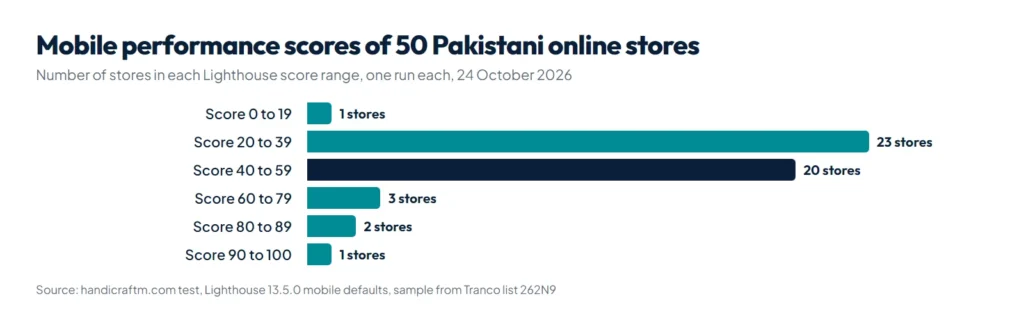
Lighthouse scores pages from 0 to 100, and Google’s scoring guide calls 90 to 100 good, 50 to 89 “needs improvement” and 0 to 49 poor. Here is how the 50 stores spread out:
- 0 to 19: 1 store
- 20 to 39: 23 stores
- 40 to 59: 20 stores
- 60 to 79: 3 stores
- 80 to 89: 2 stores
- 90 to 100: 1 store
The score is a weighted mix of five lab metrics: Total Blocking Time counts for 30%, LCP and Cumulative Layout Shift for 25% each, and First Contentful Paint and Speed Index for 10% each. A low score does not mean every visitor waits that long. It means a mid-range phone on a slow 4G connection, which is what the test simulates, waits a long time before it can see and use the page.
Which Pakistani online stores are the fastest?
These five had the highest mobile performance scores in our test. Each was tested once, so treat small gaps as noise:
| Store | Score | LCP | TBT | CLS | Platform |
|---|---|---|---|---|---|
| ethnc.com | 93 | 1.2 s | 254 ms | 0 | Shopify |
| lamaretail.com | 88 | 1.2 s | 470 ms | 0.009 | Shopify |
| khaadi.com | 84 | 4.3 s | 46 ms | 0 | Salesforce Commerce Cloud |
| beechtree.pk | 77 | 1.4 s | 978 ms | 0 | Shopify |
| insignia.com.pk | 74 | 2 s | 904 ms | 0.002 | Shopify |
What the top five share is fewer requests, a median of 114 against 290 for the whole group, and an LCP of 2.5 seconds or less on 4 of the 5. 4 of them run on Shopify, like most of the slow stores, so the platform is not what sets them apart.
Which Core Web Vitals problem is most common?
Three lab numbers map to Google’s thresholds. Largest Contentful Paint, the time until the main image or text block appears, was good (2.5 seconds or less) for 5 of 50 (10%) stores and poor (over 4 seconds) for 35 of 50 (70%); 14 stores took more than 10 seconds. Total Blocking Time, the time the page is too busy running JavaScript to respond, was inside Lighthouse’s 200 ms green band for 1 of 50 (2%) and over 600 ms for 47 of 50 (94%). Cumulative Layout Shift, how much the layout jumps while loading, was the bright spot: good (0.1 or less) for 41 of 50 (82%).
No store met all three lab targets at once. The pages are heavy: the median store sent 5.2 MB to a phone in 290 requests, and 26 of 50 sent more than 5 MB. Large hero images, sliders and autoplay videos slow LCP, and apps, trackers, chat widgets and pop-ups add JavaScript that keeps the phone busy.
Does the platform matter: Shopify or custom?
Shopify runs 44 of the 50 stores; the other 6 are split as 2 on custom code, 2 on Salesforce Commerce Cloud, 1 on Magento, 1 on Next.js. That is too few to compare platforms fairly, but the sample shows something more useful: the Shopify stores alone scored anywhere from 17 to 93. Same platform, very different results, so the theme, the apps, the image sizes and the number of scripts decide speed more than the platform name does. The practical lesson, and the one we apply in our e-commerce and retail work, is fewer apps, smaller first-screen images and only the scripts a store really uses.
By domain, the 13 brand stores on .com names had a median score of 44 and the 37 stores on .pk names 38, a small gap given one run per store.
Lab data vs field data: why your score and Google’s assessment differ
Everything above is lab data. Lighthouse loads the page once on a simulated device and network: by default a mid-range phone with a 4x slower CPU and a connection of 150 ms latency and about 1.6 Mbps download, which the Lighthouse team describes as roughly the bottom 25% of 4G connections. Field data is different. It comes from real Chrome users through the Chrome UX Report (CrUX), covers the previous 28 days and is reported at the 75th percentile, according to Google’s PageSpeed Insights documentation.
The two often disagree. web.dev’s guide to lab and field differences gives the reasons: real visitors have different phones, networks and screens, many arrive with a warm cache, pages restored from the back/forward cache load almost instantly, and real users scroll and tap, which ends the LCP measurement earlier. Lab tests also cannot predict when users will interact, so they cannot measure Interaction to Next Paint (INP) the way real visits do.
Google’s Core Web Vitals assessment uses field data: a page or site passes when the 75th percentiles of LCP, INP and CLS are all good. Use lab data to find and fix problems, and field data to see what customers actually get. Our guide to the Core Web Vitals assessment explains how to read a failed result and what to fix for each metric.
We planned to add each store’s field data from the PageSpeed Insights API, but its keyless access answered every request with a daily quota error, so this study reports lab data only. You can see your own store’s field data in the top section of a PageSpeed Insights report, when Google has enough Chrome visits to show it.
What should a Pakistani store owner check first?
- Test your homepage and one product page on PageSpeed Insights, mobile tab, and compare your score with the median of 43 in this study.
- Read the field section before the score. If it says there is not enough data, use the lab numbers until traffic grows.
- Fix LCP first. Size and compress the hero image or first slide, and avoid autoplay video and sliders above the fold.
- Audit apps and scripts. Every review widget, chat bubble, tracker and pop-up adds JavaScript. Remove the ones you do not use.
- Re-test after each change, because a single run varies.
For WordPress and WooCommerce stores, our WordPress speed optimization guide lists the fixes in order. If you are still choosing a platform, read Shopify vs WooCommerce in Pakistan.
How we did this
Sample. We downloaded the Tranco list with ID 262N9, created on 23 October 2026 from 30 days of CrUX, Farsight, Majestic, Radar and Umbrella data. We took every domain on a commercial .pk name, left out government, education, non-profit and network names, and added a fixed list of 25 well-known Pakistani retail brands whose own stores use a .com domain, when they appear in the same list. Going down the list in rank order, a script fetched each homepage once and looked for store signals (a store platform, or a cart link plus rupee prices), and we checked each decision by hand. We left out news sites, web hosts, classifieds, food delivery and one possible store that blocked our checker. The 50 highest-ranked stores became the sample: 37 on .pk names and 13 brand stores on .com. Their Tranco ranks run from 5,290 to 91,812.
Test. We first called the PageSpeed Insights API v5 (mobile, no API key). It answered with HTTP 429 “Queries per day” quota errors on 24 October 2026, and four slow retries between 19:35 and 20:45 UTC, spaced 10 to 40 minutes apart, also failed. As a fallback we ran Lighthouse 13.5.0 locally with npx, once per store homepage, between 19:35 and 20:10 UTC on 24 October 2026, from a computer in Pakistan. We used Lighthouse’s default mobile settings, the same simulated throttling PageSpeed Insights uses, in headless Chrome 155, with a user agent that names handicraftm.com. The full reports are saved with our scripts.
What this data cannot show. Each store was tested once, and Lighthouse scores vary between runs; Google’s scoring guide suggests thinking of performance as a distribution, not one number. We tested homepages only, and product pages can be faster or slower. Without field data we cannot say whether real customers pass Core Web Vitals. Lighthouse simulates the phone and network, but the test computer still matters, especially for Total Blocking Time (its CPU benchmark ranged from 1,691 to 2,172 across runs). Six heavy pages did not finish loading within Lighthouse’s time limit, so their numbers may be incomplete. Tranco ranks global popularity signals, not Pakistani sales, and Pakistani stores on .com names outside our brand list are missing.
Summary
In our mobile website speed test of 50 leading Pakistani online stores, the median Lighthouse score was 43, the median LCP 6.3 seconds and the median Total Blocking Time 1,556 ms; 35 stores scored below 50 and none met all three lab targets. Shopify runs 44 of them, with scores from 17 to 93, so how a store is built matters more than the platform. Start with your hero image and your app list, then check your field data and the Core Web Vitals assessment. If you want a store that is fast from day one, our website development service builds online stores for businesses in Pakistan.
References
- About PageSpeed Insights, Google for Developers
- Why lab and field data can be different, web.dev
- Lighthouse performance scoring, Chrome for Developers
- Total Blocking Time, Chrome for Developers
- Throttling, Lighthouse documentation on GitHub
- Tranco list 262N9, Tranco