

On this page
- How many units does a solar system produce per day?
- How many units does a 5kW solar system produce per month?
- How many units does one solar panel produce?
- Why does solar output change through the year?
- Will a rooftop system produce this many units?
- What size solar system do you need?
- What happens to the units you do not use?
- Summary
- References
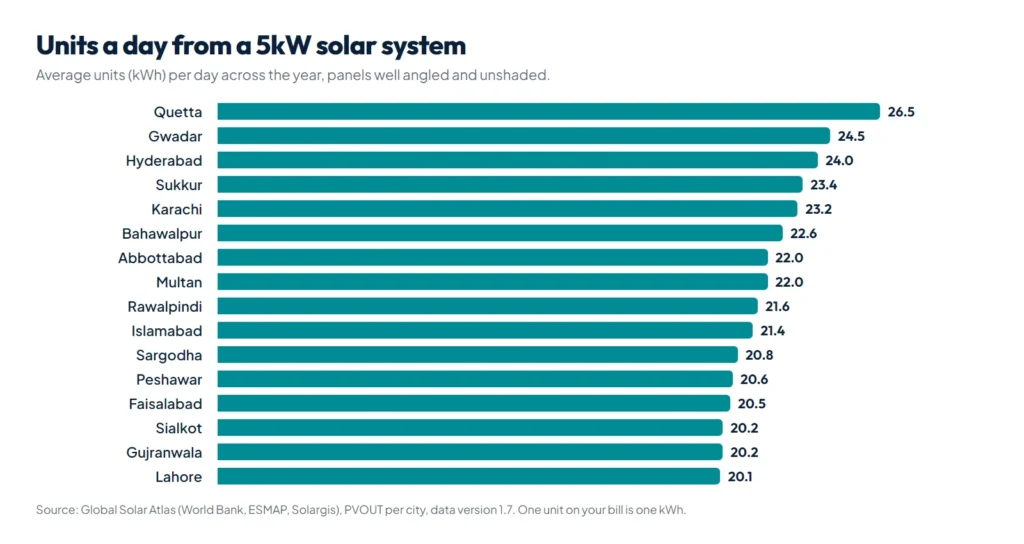
A 5kW solar system produces about 20 to 26 units (kWh) a day in Pakistan, or roughly 610 to 806 units a month, depending on the city. Lahore is at the low end with about 20 units a day, Islamabad makes about 21, Karachi about 23 and Quetta about 26.5. A 10kW system makes twice that, and one 585W panel makes about 2.3 to 3.1 units a day.
These figures come from the Global Solar Atlas, published by the World Bank and ESMAP with Solargis, which models how much electricity a solar system produces at any location. We use the same city data in our free solar system size calculator. We are a web and software company, not installers, so treat this as a planning guide and get a site survey before you buy.
How many units does a solar system produce per day?
Output depends on system size and on how much sun your city gets. The table shows average units per day across the year, for panels angled well and not shaded.
| City | 1kW | 3kW | 5kW | 10kW |
|---|---|---|---|---|
| Quetta | 5.3 | 15.9 | 26.5 | 53.0 |
| Karachi | 4.6 | 13.9 | 23.2 | 46.5 |
| Multan | 4.4 | 13.2 | 22.0 | 44.1 |
| Islamabad | 4.3 | 12.8 | 21.4 | 42.7 |
| Peshawar | 4.1 | 12.3 | 20.6 | 41.2 |
| Faisalabad | 4.1 | 12.3 | 20.5 | 41.0 |
| Lahore | 4.0 | 12.0 | 20.1 | 40.2 |
A unit on your electricity bill is one kilowatt-hour (kWh), so these numbers compare directly with your bill. Each figure is the city’s yearly output per kW from the Atlas, divided by 365 and multiplied by the system size.
How many units does a 5kW solar system produce per month?
Here is a 5kW system in all 16 cities in our calculator, with the average month and the best and worst months of the year.
| City | Units per day | Units per month (average) | Best month | Worst month |
|---|---|---|---|---|
| Quetta | 26.5 | 806 | October, 910 | February, 705 |
| Gwadar | 24.5 | 744 | March, 824 | July, 638 |
| Hyderabad | 24.0 | 730 | March, 823 | July, 636 |
| Sukkur | 23.4 | 711 | March, 796 | December, 626 |
| Karachi | 23.2 | 707 | March, 837 | August, 529 |
| Bahawalpur | 22.6 | 686 | March, 790 | January, 546 |
| Abbottabad | 22.0 | 670 | May, 802 | February, 531 |
| Multan | 22.0 | 670 | April, 763 | January, 522 |
| Rawalpindi | 21.6 | 657 | May, 786 | January, 520 |
| Islamabad | 21.4 | 650 | May, 785 | January, 513 |
| Sargodha | 20.8 | 632 | May, 756 | January, 480 |
| Peshawar | 20.6 | 626 | May, 738 | January, 498 |
| Faisalabad | 20.5 | 624 | April, 744 | January, 476 |
| Sialkot | 20.2 | 615 | May, 746 | January, 450 |
| Gujranwala | 20.2 | 613 | May, 742 | January, 454 |
| Lahore | 20.1 | 611 | April, 733 | January, 466 |
For a 10kW system, double every figure; for 3kW, multiply by 0.6. The Atlas data is for each city centre, so a nearby town gives a similar result.
How many units does one solar panel produce?
A 585W panel, a common size in Pakistan today, produces about 2.35 units a day in Lahore, 2.4 in Faisalabad, 2.5 in Islamabad, 2.6 in Multan, 2.7 in Karachi and 3.1 in Quetta. Over a month that is roughly 70 to 95 units per panel. A 5kW system needs about nine 585W panels, since 9 x 585W is 5.27kW.
The panel size comes from the Jinko Tiger Neo datasheet (560 to 585W, 2,335 x 1,134 mm). Smaller panels produce proportionally less: a 550W panel makes about 6% fewer units than a 585W one.
Why does solar output change through the year?
Day length, the height of the sun and cloud cover all change with the season, and so do your units:
- Punjab and Khyber Pakhtunkhwa: January is the weakest month. In Lahore a 5kW system averages about 466 units in January and 733 in April, a difference of more than 50%.
- Karachi and lower Sindh: the monsoon months are the weakest. Karachi’s lowest month is August, at about 529 units, against 837 in March.
- Quetta: the most even and the highest output of the 16 cities, between about 705 and 910 units a month.
Plan your system on the yearly average, then check that the worst month still covers the loads that matter to you.
Will a rooftop system produce this many units?
Usually a little less. The Atlas models panels on a fixed frame at the best tilt for each city (about 27 to 30 degrees in the main cities) with no shade, and its estimates include typical losses from dust and wiring. On a real roof, these cut output further:
- Panels facing east or west instead of south, or lying flat.
- Shade from water tanks, stair towers, trees or the next building, even for part of the day.
- Dust left on the panels for weeks, which is common in dry, dusty months.
- An inverter that is too small for the panels, which clips output at midday.
Ask your installer for an expected yearly output in units for your roof, and compare it with the city figure above. A quote far above it is a warning sign.
What size solar system do you need?
Divide the units you use in a month by the monthly units one kW produces in your city. One kW makes about 122 units a month in Lahore, 130 in Islamabad, 141 in Karachi and 161 in Quetta.
Worked example: a home in Lahore uses 500 units a month on average. 500 divided by 122 is 4.1kW, so a system of about 4 to 5kW covers the average month. That is seven or eight 585W panels. Take the average of 12 bills, not the summer peak, and add a little if you plan to buy an inverter air conditioner or an electric car.
Our free solar system size calculator does this for 16 cities, shows the units for each month of the year, and estimates roof space, the inverter size and a backup battery for the loads you choose.
What happens to the units you do not use?
Under net billing, extra units go to the grid and the power company pays you for them. The NEPRA Prosumer Regulations 2026, notified on 9 February 2026, replaced the old net metering rules, and Dawn reported that exported units now earn about Rs 10 to 11 each instead of about Rs 26. Your system also cannot be larger than your sanctioned load. The rules are still under review, so check the current terms with NEPRA and your DISCO before you size a system for export.
Because exported units now earn much less than the units you buy, a system sized to cover your own daytime use usually pays back faster than one built mainly to sell power.
Summary
A solar system in Pakistan produces about 4 to 5.3 units a day for each kW of panels: about 20 to 26.5 units a day from 5kW and 40 to 53 from 10kW, depending on the city. Output is highest in Quetta and lower Sindh and lowest in central Punjab, it drops by up to half in the weakest month, and a shaded or badly angled roof produces less. Size your system from 12 months of bills, and use our solar calculator to see the numbers for your city.
References
- Global Solar Atlas, World Bank, ESMAP and Solargis: PVOUT data for each city, data version 1.7
- Tiger Neo 560 to 585W datasheet, Jinko Solar
- Nepra pulls the plug on net-metering, Dawn, 10 February 2026
- National Electric Power Regulatory Authority (NEPRA)