On this page
SEO for beginners, in simple words: SEO (search engine optimization) means helping Google understand your pages so they show up when people search for what you offer. In Urdu it is often called سرچ انجن آپٹیمائزیشن, and the basics are the same in any language: pick the words people search, write a clear page that answers them, give each page a good title, make the site fast on a phone, and earn links and reviews. This guide explains SEO step by step for beginners in Pakistan, with an English, Urdu and Roman Urdu glossary and a short Urdu summary.
We do SEO for Pakistani businesses and run our own site’s SEO, and we have studied how Pakistanis search in English, Roman Urdu and Urdu script. The definitions below follow Google’s own SEO Starter Guide, checked in November 2026.
What is SEO?
Google’s starter guide describes SEO as helping search engines understand your content and helping users decide whether to visit your site from the results. It is not a trick. Google says there is no guarantee that any site will be indexed or ranked, and no secret that puts you first. What works is a site that answers searches better than the other results.
SEO has three parts:
- On page SEO: the words, titles, headings and images on each page.
- Technical SEO: whether Google can crawl the site, how fast it loads and whether it works on phones.
- Off page SEO: links from other sites, reviews and your Google Business Profile.
SEO glossary in English, Urdu and Roman Urdu
| English term | Urdu | Roman Urdu | Meaning |
|---|---|---|---|
| Search engine optimization | سرچ انجن آپٹیمائزیشن | search engine optimization | Making pages easy for Google to understand and show |
| Keyword | کلیدی لفظ | kaleedi lafz | The words people type into Google |
| Ranking | درجہ بندی | darja bandi | Your position in the search results |
| Title tag | صفحے کا عنوان | safhe ka unwan | The blue clickable line in Google results |
| Meta description | مختصر تفصیل | mukhtasar tafseel | The short text that can appear under the title |
| Backlink | بیک لنک | backlink | A link to your site from another site |
| Indexing | انڈیکسنگ | indexing | Google storing your page so it can show it |
| Crawling | کرالنگ | crawling | Google’s robot visiting and reading your pages |
| Search intent | تلاش کا مقصد | talash ka maqsad | What the person really wants from a search |
| Local SEO | مقامی ایس ای او | muqami SEO | Showing up in Google Maps and “near me” searches |
Many Pakistani business owners use the English words even when speaking Urdu, so do not be afraid of the English terms. Learn them once and every tutorial becomes easier.
How do you do SEO step by step?
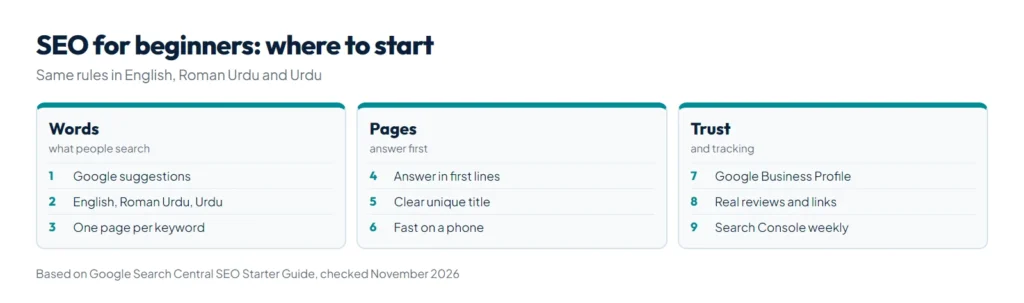
- Find your keywords. Type your service into Google and note the suggestions that appear as you type. Try English, Roman Urdu (“website banwane ki qeemat”) and Urdu script, because Pakistanis search in all three. Our study of Roman Urdu keywords shows which forms Google completes for 120 topics.
- Make one page per main keyword. One page for “website design in Lahore”, another for “online store development”. Do not put every service on one page.
- Answer the question in the first lines. Then add details, prices, steps, photos and an FAQ. Write for people first.
- Write a clear title and description. Google’s guide says a good title is unique to the page, clear and concise, and accurately describes the page. Keep the main keyword near the start.
- Fix the technical basics. The site must load fast on a phone, use HTTPS, and let Google crawl it. A simple robots.txt file, made with our free robots.txt generator, tells crawlers what they may visit.
- Set up local SEO if you serve a city: a complete Google Business Profile, real reviews and the same name, address and phone everywhere. See local SEO in Pakistan.
- Connect Google Search Console. It is free and shows which searches show your pages, your clicks and any indexing problems. Google’s Search Console help explains setup.
- Be patient and measure. Google’s guide says some changes show within hours and others take months, and suggests waiting a few weeks before judging a change.
What does an SEO friendly page look like? A worked example
Say you run a tailoring shop in Lahore and want the search “ladies tailor in Lahore”. This is how the main parts of that page could look:
| Part of the page | Example | Why |
|---|---|---|
| URL | yoursite.pk/ladies-tailor-lahore/ | Short, readable, with the keyword |
| Title tag | Ladies Tailor in Lahore: Stitching from Rs 1,500 | Your Shop | Keyword first, a reason to click, under 60 characters |
| Meta description | Ladies tailor in Lahore for suits, bridal and alterations. Delivery in 5 days, home measurement in DHA and Gulberg. Book on WhatsApp. | What you do, where, and the next step |
| H1 heading | Ladies tailor in Lahore | One H1 that matches the search |
| First lines | Prices, delivery time and areas you cover | Answers the question straight away |
| Subheadings | “Stitching prices”, “How long does stitching take?”, “Do you take home measurements?” | Real questions people ask |
| Images | Your own photos with alt text such as “bridal lehenga stitched in our Lahore shop” | Shows real work, helps image search |
| FAQ | Five short questions and answers, some in Roman Urdu | Matches more searches and AI answers |
The prices and areas here are only placeholders; use your own real details. A page like this, plus a complete Google Business Profile and a few real reviews, beats most local competitors who have only a Facebook page.
Should you write your website in Urdu or English?
Write in the language your customers search in. For many Pakistani services that is English with Roman Urdu phrases, while news, religion and some consumer topics get many Urdu script searches. A few practical rules:
- Use one language per page and give each language its own URL, rather than mixing both on one page.
- Write real Urdu, not machine translation. Readers notice, and thin translated pages do not help you.
- Check length the right way. Urdu word counts differ from English character counts. Our free Urdu word counter counts Urdu and mixed text, with reading time.
- Use Roman Urdu in FAQs and headings where people search that way, for example “SEO kya hai”.
What SEO mistakes should beginners avoid?
- Keyword stuffing. Repeating a keyword makes the page worse to read and does not help.
- Relying on the meta keywords tag. Google’s guide says Google Search does not use it.
- Buying cheap backlinks. Paid link schemes break Google’s spam policies and can hurt you.
- Copying content from other sites. Pages that add nothing new rarely rank.
- Expecting results in a week. SEO builds over months.
Urdu mein mukhtasar: SEO کیا ہے؟
ایس ای او کا مطلب ہے اپنی ویب سائٹ کو اس طرح بنانا کہ گوگل اسے سمجھ سکے اور لوگوں کو تلاش کے نتائج میں دکھائے۔ پہلے وہ الفاظ معلوم کریں جو لوگ گوگل میں لکھتے ہیں، پھر ہر اہم لفظ کے لیے ایک واضح صفحہ بنائیں جو سوال کا سیدھا جواب دے۔ ہر صفحے کا عنوان صاف اور مختصر رکھیں، ویب سائٹ کو موبائل پر تیز بنائیں، اور گوگل سرچ کنسول لگا کر نتائج دیکھیں۔ ایس ای او میں وقت لگتا ہے، اس لیے صبر کریں اور اچھا مواد لکھتے رہیں۔
Summary
SEO for beginners comes down to helping Google understand your pages: find the words people search in English, Roman Urdu and Urdu, make one clear page per main keyword, answer the question first, write a good title, fix speed and crawling, set up local SEO and track everything in Search Console. Avoid stuffing, bought links and copied content, and give it months, not days. For your next steps, work through our SEO checklist for small business websites, and check Urdu page length with our free Urdu word counter. If you would rather have it done for you, see our SEO service.