On this page
The most reliable way to get clients for web development is to find businesses with a clear website problem, such as no website, a social page only or a site with no contact form, and send each one a short, specific message about that problem with a quick example of the fix. In our own Google Maps lead lists, 35.9% of 551 Pakistani businesses had no website of their own, against 18.7% of 2,201 US businesses, so the demand is real if you look for it. This guide shares that data, then covers the channels that work, the outreach messages, pricing your first projects and turning one client into the next.
We are a small web and software company in Pakistan, and we find many of our own clients this way. The numbers below come from eight lead lists we collected for our outreach between 12 October and 1 November 2026. We explain the method and its limits at the end, so you can judge them yourself.
How many businesses still need a website?
| Listings on Google Maps | Pakistan (551) | USA (2,201) |
|---|---|---|
| No website listed at all | 30.3% | 15.6% |
| No website of their own (none, social page only, free builder or directory page) | 35.9% | 18.7% |
| Own website | 64.1% | 81.3% |
The Pakistani lists were sportswear manufacturers in Sialkot and interior designers in Karachi, Lahore, Islamabad and other cities. The US lists were local shops and services in Houston, Dallas, Miami and New Jersey, and interior designers across the US. Even among businesses that do have a website, our one time check of the 1,787 own sites that loaded found clear gaps:
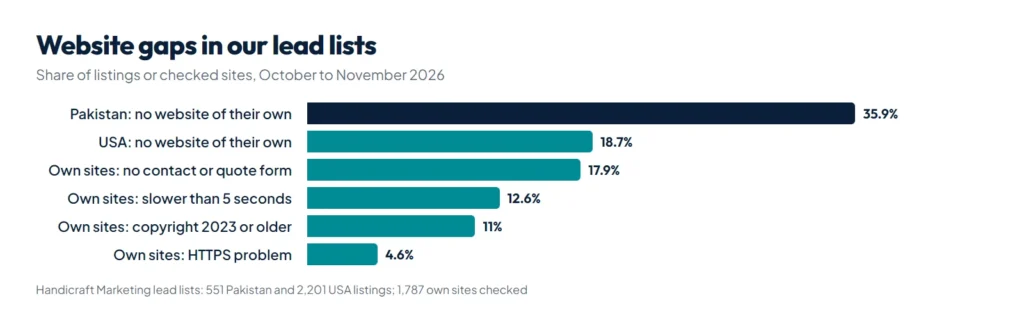
- 17.9% had no contact or quote form we could find on the pages we checked.
- 12.6% took more than 5 seconds to respond to our check.
- 11.0% still showed a copyright year of 2023 or earlier, a sign nobody updates the site.
- 4.6% did not load correctly over HTTPS, and 2.0% had no mobile viewport tag.
Every one of those is a reason to write to a business, and a better opener than “do you need a website?”.
Where do web developers find clients?
| Channel | How it works | Good for | Watch out for |
|---|---|---|---|
| Google Maps prospecting | Search a niche and city, list businesses with a website problem, contact them | Local businesses, steady small projects | Takes daily effort; respect people who say no |
| Your own network | Friends, family businesses, former employers, local associations | First 2 or 3 projects and testimonials | Do not work for free forever |
| Freelance marketplaces | Upwork, Fiverr and similar sites match buyers and sellers | International clients, building reviews | Commission on every order and heavy price competition |
| Partnerships | Designers, marketers, accountants and printers who refer clients | Repeat referrals | Agree on referral terms in writing |
| Your own content | Case studies, guides and free tools that rank in Google | Inbound leads that already trust you | Slow to start, months not weeks |
Most new developers do best by combining one active channel, such as Maps prospecting, with one slow channel, such as case studies on their own site.
How do you find businesses that need a website?
- Pick one niche and one city, for example clinics in Lahore or interior designers in Karachi. A niche lets you reuse examples and speak their language.
- Search Google Maps for that niche and note each business: name, phone, website field, rating and number of reviews.
- Sort by problem: no website, social page only, broken site, no contact form, not mobile friendly, very old.
- Score each lead by need and by ability to pay. A business with 200 reviews and no website is a better lead than one with 3 reviews.
- Check the details by hand before you write. Open the site on your phone and confirm the problem is real today.
What should your outreach message say?
Short, specific and about them. Name the problem you saw, show a quick fix, and ask a small question. A message like this works better than a long pitch:
Assalam o Alaikum [name], I found [business] on Google Maps.
You have [210] reviews, but no website, so people who search
"[service] in [city]" only see your Maps listing.
I made a quick one page example of what your site could look like: [link]
Would it help if I sent a price for a simple 5 page site?
Rules that keep outreach honest and effective:
- Send one message and at most one follow up. Stop if they say no or do not reply.
- Use the business’s public contact channel and never add people to groups or broadcast lists without consent.
- Never invent results. Show your real past work or a demo, not claims you cannot prove.
- Make it easy to reply. A WhatsApp link with a ready message, made with our free WhatsApp link generator, lowers the effort for a busy owner.
How should you price your first web development projects?
Price by scope, not by hours, and write the scope down: number of pages, who writes the text, who provides photos, contact form, WhatsApp button, basic SEO, and how many rounds of changes. Offer two or three clear packages instead of a single number. For a sense of what Pakistani clients pay, see our website price in Pakistan guide. Ask for an advance before you start, commonly half, and the rest before the site goes live on their domain.
How do you turn one client into the next?
- Ask for a review and a referral the week the site goes live, when the client is happiest.
- Write a short case study: the problem, what you built, and a real result if the client agrees to share it.
- Offer a monthly care plan for updates, backups and security, so each client becomes recurring income.
- Work in one niche long enough that clients in it start to recommend you.
Clients compare developers before they hire. Our guide on how to choose a website developer lists what they check, which is exactly what your portfolio and proposal should answer.
How we did this
We used eight Google Maps lead lists we built for our own outreach between 12 October and 1 November 2026: 551 Pakistani listings (205 Sialkot sportswear manufacturers and 346 interior designers in Pakistani cities) and 2,201 US listings (local shops and services in Houston, Dallas, Miami and New Jersey, and US interior designers). Each listing was classed from its website field and a check of the link as no website, social page only, free builder, directory page or own website. For own websites, a script made one request per site and checked HTTPS, the mobile viewport tag, response time, the copyright year and whether a contact or quote form appeared on the home page or a few linked pages. The figures cover the 1,787 sites that returned a normal page.
Limits: these are lists for niches we chose, not a random sample of all businesses, so the percentages describe our lists, not every business in either country. Google Maps data can be out of date, a single check can catch a slow moment, and a form on a page we did not check would be missed.
Summary
To get clients for web development, pick a niche and city, find businesses with a visible website problem on Google Maps, and send each one a short message about that exact problem with a quick example. In our lists, 35.9% of Pakistani businesses and 18.7% of US businesses had no website of their own, and many with sites lacked a form, speed or updates. Price by written scope, ask for reviews and referrals, and add a care plan. Make replying easy with a link from our free WhatsApp link generator, and read how clients choose a website developer before you write your next proposal.
References
- Handicraft Marketing lead lists and website checks, 12 October to 1 November 2026 (method above)
- Google Business Profile Help: Tips to improve your local ranking