
On this page
- What are Roman Urdu keywords?
- Does Google autocomplete Roman Urdu searches in Pakistan?
- Which kinds of Roman Urdu searches does Google know best?
- Qeemat, keemat or kimat: which spelling does Google prefer?
- Why does “in hindi” appear in Pakistani searches?
- How should a Pakistani business target Roman Urdu keywords?
- How we did this
- What autocomplete cannot tell you
- Summary
- References
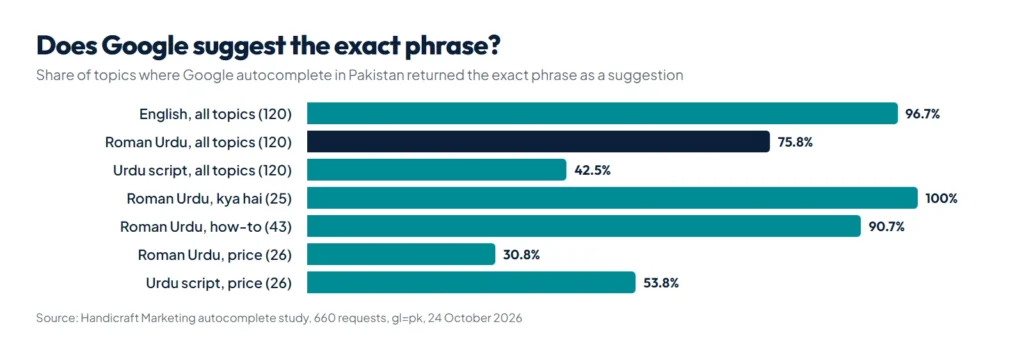
Roman Urdu keywords are real Google searches in Pakistan, and for most business topics Google recognizes them almost as well as English. In our test of 120 business and service topics, Google autocomplete in Pakistan suggested the exact Roman Urdu phrase for 91 (76%), the English phrase for 116 (97%) and the Urdu-script phrase for 51 (43%). Spelling matters: Google completes “kimat”, “kaise banaye” and “kya hai”, and rarely or never “qeemat”, “banayen” or “kia hai”.
We do SEO for businesses in Pakistan and built a free Urdu word counter for Urdu and mixed text. To see which Roman Urdu phrasings Google itself recognizes, we sent 660 autocomplete requests from a connection in Pakistan on 24 October 2026 and saved every response. The method and the limits are at the end.
What are Roman Urdu keywords?
Roman Urdu is Urdu written in the Latin alphabet, the way many Pakistanis type on their phones: “website kaise banaye” instead of “ویب سائٹ کیسے بنائیں”. A Roman Urdu keyword is a search phrase in that form, often mixed with English words such as website, price or online. There is no fixed spelling, so the same question can be typed as qeemat, keemat, kimat or qimat. That is why it pays to check which forms Google actually knows before you write a page around one.
Does Google autocomplete Roman Urdu searches in Pakistan?
Yes, for most topics. We wrote each topic three ways with the same meaning and asked Google for suggestions with the country set to Pakistan.
| Phrase form | Topics with any suggestion | Exact phrase suggested | Full list of 10 |
|---|---|---|---|
| English (how to make a website) | 120 (100%) | 116 (96.7%) | 116 |
| Roman Urdu (website kaise banaye) | 106 (88.3%) | 91 (75.8%) | 74 |
| Urdu script (ویب سائٹ کیسے بنائیں) | 55 (45.8%) | 51 (42.5%) | 13 |
English still covers everything, but Roman Urdu is close behind and far ahead of Urdu script. Roman Urdu got more suggestions than Urdu script for 91 topics, Urdu script got more for 12, and 17 were tied. Every topic that worked in Roman Urdu or Urdu script also worked in English. Switching Google’s interface language from English to Urdu changed nothing: the Urdu-script suggestion lists were identical for all 120 topics.
Which kinds of Roman Urdu searches does Google know best?
| Search type | Example | Topics | Roman Urdu phrase suggested | Urdu-script phrase suggested |
|---|---|---|---|---|
| What is | seo kya hai | 25 | 25 | 15 |
| How to | invoice kaise banaye | 43 | 39 | 11 |
| Price | solar panel ki qeemat | 26 | 8 | 14 |
| Fees | passport ki fees | 6 | 5 | 2 |
| Cheap | sasta umrah package | 6 | 6 | 2 |
| Online | online shopping kaise kare | 9 | 5 | 3 |
| Other | mobile qiston par | 5 | 3 | 4 |
Explainer and how-to phrases work almost perfectly in Roman Urdu: all 25 “kya hai” phrases and 39 of 43 how-to phrases came back word for word. Price phrases are the weak spot: only 8 of the 26 Roman Urdu price phrases, most of them written with “ki qeemat”, came back word for word, fewer than the 14 Urdu-script price phrases. For everyday purchases Urdu script is strong: mobile, iPhone, laptop, AC, Honda 125, Alto, cement, solar panel, gold and the dollar rate each returned a full list of 10 Urdu-script suggestions.
Qeemat, keemat or kimat: which spelling does Google prefer?
We tested 20 products and services with four spellings of “price”, then typed only the item and “ki” (for example “solar panel ki”) to see what Google offered on its own.
| Spelling | Items with any suggestion | Exact phrase suggested |
|---|---|---|
| ki kimat | 15 of 20 | 13 |
| ki keemat | 15 of 20 | 7 |
| ki qeemat | 12 of 20 | 6 |
| ki qimat | 15 of 20 | 0 |
From the short prefix, Google’s own completions included “ki price” for 15 of the 20 items and “ki kimat” for 10. “Qeemat” and “keemat” did not appear once. Questions with “kitne”, such as “iphone kitne ka hai”, appeared in 13 of the 20 lists. Two more spelling tests gave equally clear winners:
- kaise banaye was suggested word for word for all 10 items we tested (website, logo, invoice, mobile app and others). “banayen”, “banaen” and “banain” were suggested for none, and “kaise banate hain” appeared for 6.
- kya hai was suggested for all 10 items; “kia hai” for none, even though Google still returned other suggestions.
Google also nudged other phrasings toward one form, for example “english bolna kaise seekhe” toward “sikhe” and “freelancing kaise shuru kare” toward “karen”. The practical rule: use the spelling Google completes, which is usually the plainest phonetic one, and expect many people to mix in the English word “price”.
Why does “in hindi” appear in Pakistani searches?
Roman Urdu and Hindi written in English letters often look the same on screen, and autocomplete shows it. Although every request was set to Pakistan, 46 of the 120 Roman Urdu lists (38%) included a suggestion mentioning Hindi, 75 suggestions in all, such as “seo kya hai in hindi” and “website kaise banaye in hindi”. Only 22 lists had a suggestion mentioning Urdu.
The other forms looked very different. Only 3 of 1,193 English suggestions mentioned Hindi, and 352 (29.5%) mentioned Pakistan, against 23 of 899 Roman Urdu suggestions (2.6%). Urdu-script suggestions never mentioned Hindi, 29 of 217 mentioned پاکستان, and none of the 660 responses used the Devanagari (Hindi) script. Only 9 Urdu-script suggestions mixed in Latin words, such as phone brands and “pdf”.
So a Roman Urdu page may compete with Hindi content written for India. In our view, plain Pakistan signals such as PKR prices, Pakistani cities and local payment options help a searcher see at once that the page is meant for them.
How should a Pakistani business target Roman Urdu keywords?
- Start from what customers type. Google’s SEO Starter Guide notes that some users search “charcuterie” and others “cheese board”, and says that writing naturally with varied words gives you “more chances to show up in Search”. For many Pakistani customers the other word is Roman Urdu. Use it where it reads naturally: an FAQ question such as “Website kaise banaye?”, a subheading, or a line in the answer.
- Use Google’s spelling, not every spelling. One natural mention of “kimat” or “kaise banaye” is enough. The same guide says keyword stuffing is against Google’s spam policies, so never list qeemat, keemat, kimat and qimat on one page. Our SEO checklist covers the other on-page basics.
- Match the language to the intent. Our view, from this data: for price and buying searches, an English page with clear PKR prices and the Roman Urdu phrase in a heading fits what people type. For “kya hai” and “kaise” searches, people often add “in urdu” or “in hindi”, which suggests they want the explanation itself in Urdu, as text or video.
- Keep one language per page. Google’s guide to multilingual sites says it uses “the visible content of your page to determine its language”, not lang attributes or the URL. It recommends a different URL for each language version and a single language for the content and navigation of each page. If you publish a full Urdu version, give it its own URL and link the versions with hreflang annotations, which use ISO 639-1 language codes (ur for Urdu). A few Roman Urdu phrases on an English page are not a translation and, in our view, need no separate version.
- Use Urdu script where it is strong. Urdu-script searches were strongest for everyday prices and a few public topics: the ten price phrases above, پاسپورٹ کی فیس (passport fee) and عمرہ کا طریقہ (how to perform umrah) each returned 10 suggestions. When you write an Urdu or mixed page, our Urdu word counter counts Urdu and English words separately.
- Measure what already works. The Queries tab of the Search Console Performance report groups data by “the search query users typed”, so you can see which Roman Urdu phrases already bring impressions and build on those. Our local SEO guide for Pakistan covers city pages and the rest of the local picture.
How we did this
- Topics: 120 business and service topics in seven groups: web and software (30), online business (13), travel and documents (19), solar and energy (10), education (7), tax and money (19), and small business and products (22). No job searches. Each topic was written three ways with the same meaning: English, Roman Urdu (using “kaise banaye”, “kya hai”, “ki qeemat”, “sasta” and “online” patterns) and Urdu script.
- Requests: Google’s public autocomplete endpoint (suggestqueries.google.com, client=firefox, gl=pk). English and Roman Urdu used hl=en; Urdu script was sent with both hl=ur and hl=en. Spelling tests: 20 items with 4 price spellings, 10 items with 4 spellings of “banaye”, 10 items with “kya hai” and “kia hai”, and one short prefix per item. 660 requests in all on 24 October 2026, from one connection in Pakistan, signed out, at most one request every 0.75 seconds, with a user agent naming handicraftm.com. No request failed.
- Measures: whether any suggestion came back, whether the exact phrase was itself one of the suggestions (Google returned at most 10), and the scripts and words used in each suggestion.
- Tools: Python 3.12 with the requests library. The topic list, scripts, raw responses and results are saved with this study.
What autocomplete cannot tell you
- It shows that a query exists, not how often it is searched. Google’s help page on autocomplete says predictions “reflect real searches”, but also that autocomplete “doesn’t simply display the most common queries”. A Roman Urdu phrase with 10 suggestions may still get far fewer searches than its English version. Use Search Console or a keyword tool for volume.
- Location and history shape predictions. Google lists the language of the query, its location and trending interest as factors, and signed-in users can see predictions based on past searches. We used one connection in Pakistan, signed out, on one day.
- Some predictions are removed by policy, so a missing suggestion does not prove that nobody searches for it.
- The wordings are ours. Each topic had one Roman Urdu and one Urdu-script phrasing, and the spelling tests show that a different wording can do better or worse.
Summary
Roman Urdu keywords are worth targeting in Pakistan. Google autocomplete suggested the exact Roman Urdu phrase for 91 of 120 business topics, against 116 in English and 51 in Urdu script, and it was strongest for “kya hai” and “kaise” searches. Spelling decides a lot: “kimat”, “kaise banaye” and “kya hai” are the forms Google completes, and many people simply type “price”. Roman Urdu results also mix with Hindi, so make the Pakistani focus of your page obvious. Write the phrases naturally, keep one language per page, and check real queries in Search Console. Our Urdu word counter helps with Urdu and mixed copy, and our SEO and AI search optimization service can plan the keywords and pages for you.
References
- Google Search Help: How Google autocomplete predictions work
- Google Search Central: SEO Starter Guide
- Google Search Central: Managing multi-regional and multilingual sites
- Google Search Central: Tell Google about localized versions of your page
- Search Console Help: Performance report (Search results)