
On this page
- Do you need your own website if you already list on portals?
- Which features does a property website need?
- What should every listing page show?
- How should leads reach your agents?
- What must a real estate website show by law?
- What drives the cost of a real estate website?
- A launch checklist
- Summary
- References
A real estate website in Pakistan earns its cost when it does what portals cannot: it shows only your own verified listings and projects, sends every inquiry to the right agent on WhatsApp with the listing ID attached, and displays the registration or approval numbers the law asks for. Keep using portals for reach, and use your own site to own your leads, your listing data and your name. This guide covers when a site is worth it, the features that matter, what the law says a project page must show, and what drives the cost.
We build websites and lead systems for businesses in Pakistan, and real estate is one of the industries we design for; our real estate website design page shows the page types we build. The legal points below come from the text of the Islamabad Real Estate (Regulation and Development) Act, 2020 and the Sindh Building Control Ordinance, 1979, read in October 2026. We are not lawyers, so confirm your own case with one.
Do you need your own website if you already list on portals?
Portals bring buyers who are already searching, so keep using them. But on a portal you rent space next to your competitors. Zameen’s own app guide (December 2022) explains that you buy a “Listing Quota” to post an ad, with one listing slot for one year per quota, and spend credits to boost a listing or refresh it to the top. Your own site works differently:
| Question | Property portal | Your own website |
|---|---|---|
| Who finds you | Buyers already browsing the portal | People who search your name or an area you cover, or click your ads |
| Competitors on the page | Yes, listed next to yours | None |
| Where the inquiry goes | Through the portal’s own contact tools and rules | Straight to your WhatsApp and your records |
| How you pay | Per listing slot, plus boosts (on Zameen, quota and credits) | Build once, then hosting and upkeep |
| Best for | Volume listings and reach | Projects, exclusive listings, trust and repeat clients |
Most agencies need both. Use portals to be found, and your website as the place where serious buyers check your projects, your registration details and your history before they visit.
Which features does a property website need?
Start with the features that turn a visit into a call, and add the rest later.
| Feature | Why it matters | When |
|---|---|---|
| Search with filters: city, area or society, plot, house, flat or shop, size, budget, sale or rent, installments | Buyers arrive with a budget and an area in mind | At launch |
| One page per listing with a stable URL and ID | It can be shared on WhatsApp, found on Google and referred to on calls | At launch |
| Status on every listing: available, under offer, sold or rented | A sold property marked available wastes the buyer’s call and your agent’s time | At launch |
| Map on each listing and project | Buyers check the location first | At launch |
| WhatsApp button with the listing ID in the first message | The agent knows which property the buyer means | At launch |
| Project pages with payment plan, approval number and documents | Required for some projects by law, and what careful buyers look for | At launch, if you sell projects |
| Agent profiles with registration numbers | Trust, and Islamabad’s law makes agents quote their number | At launch |
| A “list your property” form for owners | Brings in new stock | Soon after |
| Area guides for each society or neighborhood you cover | Can rank for area searches and answers buyers’ questions | Soon after |
| Saved searches and new-listing alerts | Brings buyers back | Later |
What should every listing page show?
Treat each listing as a record with the same fields, so the filters work and nothing is missing:
- Listing ID, shown on the page and sent in the WhatsApp message.
- Purpose and type: sale or rent; plot, house, flat, shop or office.
- Location: city, society or area, block or phase, and a map pin.
- Size in marla or kanal and in square feet, so buyers can compare like with like.
- Price or a price range, and whether installments are available.
- Status and the date the listing was posted or last checked.
- Photos and video of the actual property, compressed for mobile data.
- Agent name, WhatsApp number and registration number, where one applies.
- For project units: the project’s approval or registration number and the authority that issued it.
Keeping these as structured fields also lets you add markup later. Schema.org has a RealEstateListing type, still in its “new” area, with a datePosted property for when a listing went live.
How should leads reach your agents?
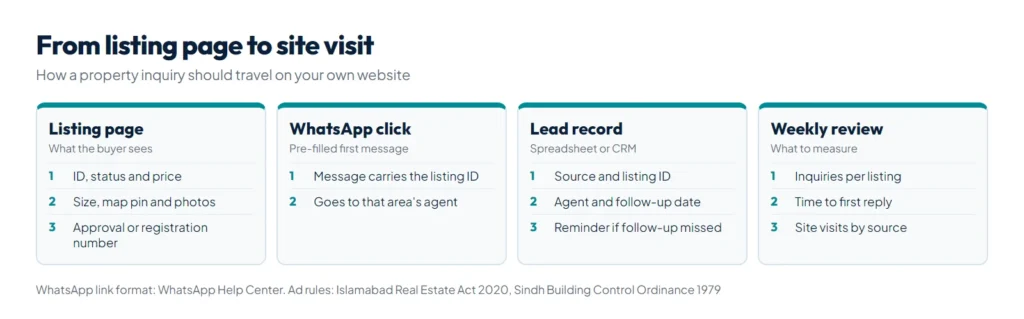
Make WhatsApp the main contact button, and pre-fill the first message so the agent knows which property the buyer saw. WhatsApp’s click to chat help page gives the format: wa.me, then the full number in international format without leading zeros, brackets or dashes, then a URL-encoded message. For the mobile number 0300 1234567, that becomes:
https://wa.me/923001234567?text=Hi%2C%20I%20am%20interested%20in%20listing%20DHA-1043Our free WhatsApp link generator builds these links, with a QR code, in your browser. Then decide where each lead goes:
- Route by listing or area: each listing carries its own agent’s number, or each society maps to one agent.
- Record the source: website, portal, Facebook or Google ad, together with the listing ID.
- Set a follow-up date for every inquiry, with a reminder if it is missed.
- Review weekly: inquiries per listing, time to first reply, and which sources lead to site visits.
A shared spreadsheet works for a small office; with several agents, a CRM keeps leads from going cold. Our guide to CRM for small businesses compares spreadsheets with free, paid and custom CRMs.
What must a real estate website show by law?
Rules differ by city, so check the ones that apply to you. Two laws are clear about advertising, and both are worded broadly enough that a project page on your website is safest treated as an advertisement.
- Islamabad. The Islamabad Real Estate (Regulation and Development) Act, 2020 says no developer may advertise, market, book or sell plots, apartments or buildings in a real estate project without first registering it with the Real Estate Regulatory Authority. Its definition of advertisement covers publicity in any form. Every advertisement or prospectus must prominently mention the Authority’s website address and the project’s registration number, and registered agents must quote their registration number in every sale they facilitate.
- Sindh. The Sindh Building Control Ordinance, 1979 bars developers from selling or advertising plots without a no objection certificate from the Authority, and bars builders from selling or advertising a building “through any audiovisual aids or any other means” before written approval. The advertisement must mention that approval.
For your website, that means a field for the approval or registration number on every project page and ad, a link to the authority’s own website where buyers can check it, the agent’s registration number on agent profiles, and no project page before its approval arrives. Our real estate industry page also covers the Lahore rules and how buyers check approved schemes.
What drives the cost of a real estate website?
The price of a property website depends mostly on a few choices:
| Cost driver | Lower cost | Higher cost |
|---|---|---|
| Listings | You add a few each week by hand | Importing hundreds from spreadsheets or another system, with photo processing |
| Search | A handful of filters on one listings page | Map-based search, saved searches and alerts |
| Maps | An embedded map per listing; Google says its Maps Embed API is free with unlimited requests | Interactive map search, which uses other Google Maps products with their own pricing |
| Leads | WhatsApp links and a form that emails you | A CRM with routing, reminders and reports |
| Projects | One page per project from a template | Interactive master plans with plot availability |
| Languages | English | English and Urdu, with right-to-left layout |
| Content | You supply photos and text | Area guides and project pages written for you |
For typical price ranges, see our guide to website prices in Pakistan. A sensible order is to launch with listings, project pages, WhatsApp routing and the legal details, then add alerts, area guides and a CRM once inquiries are flowing.
A launch checklist
- Every listing has an ID, status, price or range, size, map pin and agent.
- Sold and rented listings are marked or removed within a day.
- Every project page shows its approval or registration number and links to the authority.
- WhatsApp buttons carry the listing ID, and each lead reaches a named agent.
- Every inquiry gets a source and a follow-up date.
- Pages load quickly on mobile data, with compressed photos.
- Your Google Business Profile links to the website, and the website links back to your profiles.
Summary
A real estate website in Pakistan should work alongside portals, not replace them. Portals bring reach; your own site holds your verified listings, sends WhatsApp inquiries with the listing ID to the right agent, and shows the registration or approval numbers that Islamabad’s 2020 Act and Sindh’s Building Control Ordinance require in advertising. Build the listing record, the lead routing and the legal details first, then grow with area guides and a CRM. See how we approach it on our real estate websites page, or ask our website development team for a quote.
References
- Zameen app features and updates, Zameen.com blog, 21 December 2022
- How to use click to chat, WhatsApp Help Center
- Islamabad Real Estate (Regulation and Development) Act, 2020, Gazette of Pakistan via FAOLEX
- Sindh Building Control Ordinance, 1979, Sindh Judicial Academy
- Maps Embed API usage and billing, Google for Developers
- RealEstateListing, Schema.org