On this page
- What is the difference between Google Ads and Facebook ads?
- Which is better for your type of business?
- Can Google Ads do what Facebook ads do, and the other way round?
- How should you split a small budget between Google and Meta?
- How do you measure Google Ads and Facebook ads fairly?
- Mistakes that waste money on both platforms
- Summary
- References
Google Ads shows your ad to people who are already searching for what you sell, while Facebook and Instagram ads (Meta ads) show it to people picked by location, age, interests and similarity to your customers, before they search. In the Google Ads vs Facebook ads choice, start with Google when customers look for you, as with clinics, repairs and B2B services, and with Meta when people buy what they see, as with clothing, food and events. Then measure cost per sale on both with the same yardstick and move money to the one that wins.
We plan and run Google and Meta campaigns for businesses in Pakistan through our performance marketing service. The platform rules below come from Google Ads Help and the Meta Business Help Center, checked in October 2026. We do not quote average click or impression prices for Pakistan, because neither Google nor Meta publishes them; the only reliable numbers are the ones from your own account.
What is the difference between Google Ads and Facebook ads?
The core difference is intent versus interest. On Google Search, keywords match your ads to the terms people search for, so the person has already said what they want. On Meta, you choose an audience by location, age, gender, language, interests and behaviors, or from your own customers through custom and lookalike audiences, and the ad appears while they scroll.
| Question | Google Ads | Meta ads (Facebook and Instagram) |
|---|---|---|
| How a person meets your ad | They search for something that matches your keywords | They fit the audience you chose while browsing |
| What you target | Keywords and locations; price depends on bid, competition and Quality Score | Location, age, gender, language, detailed targeting, custom and lookalike audiences |
| Where ads show | Google Search; Demand Gen adds YouTube and Shorts, Discover, Gmail, Maps and Display | Facebook, Instagram, Messenger, WhatsApp and the Audience Network |
| How people contact you | Visit your page, or call from a call asset | Visit your page, or open a WhatsApp chat from a click-to-WhatsApp ad |
| Learning period | Smart Bidding needs a standard 7 to 14 days | Ad sets leave learning after about 50 results in a week |
| How a sale is credited | Data-driven attribution by default for most conversions | Standard setting: 1 or 7 days after a click, 1 day after a view |
| See competitors’ ads | Google Ads Transparency Center | Meta Ad Library |
Which is better for your type of business?
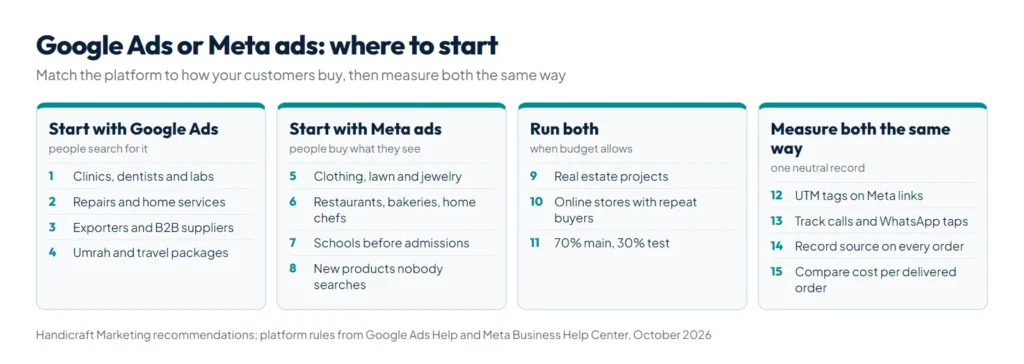
Ask one question: do your customers search for what you sell, or do they buy it when they see it? This is how we usually start for common Pakistani businesses:
| Business | Start with | Why | Add next |
|---|---|---|---|
| Clinic, dentist, lab | Google Ads | Patients search when they need care | Meta for new services and packages |
| AC repair, plumbing, home services | Google Ads with call assets | The need is urgent and people call | Meta to past site visitors |
| Clothing, lawn, jewelry | Meta ads | People buy what looks good in a video or photo | Google Search for your brand and exact product names |
| Restaurant, bakery, home chef | Meta ads by area | Food sells on sight, close to home | A free, complete Google Maps profile |
| Exporter or manufacturer | Google Ads in the buyer’s country | Buyers search for suppliers with specific terms | Meta to past site visitors |
| Real estate project | Both | People search for areas, then decide on photos and video | Lead follow-up on WhatsApp |
| Umrah or travel agency | Google Ads for package searches | Searches rise with dates and seasons | Meta before Ramadan and the holidays |
| School, academy, coaching | Meta before admissions | Parents and students need to hear about you first | Google for admission searches |
For a shop or clinic, also do the free part first: our guide on how to rank on Google Maps often brings calls that cost nothing per click.
Can Google Ads do what Facebook ads do, and the other way round?
Partly. Google’s Demand Gen campaigns show image and video ads on YouTube, Shorts, Discover, Gmail, Maps and the Display Network, and can use lookalike segments built from your past buyers, site visitors or YouTube viewers. That is close to how Meta ads work. Meta, on the other hand, has nothing like search intent: nobody types “AC repair DHA” into Instagram and gets your ad because of those words. If your business depends on people asking for it by name, you need Google Search somewhere in the plan.
How should you split a small budget between Google and Meta?
A thin budget split across both platforms often teaches you nothing. Meta says an ad set leaves its learning phase after about 50 results in the week after its last significant edit, warns that very small budgets give the system a poor signal, and advises fewer ad sets. Google says Smart Bidding needs a standard 7 to 14 day learning phase. So use these rules:
- If the budget cannot feed both, run one. Pick the platform from the table above.
- Put about 70% on your main platform and 30% on a test of the other. This is our rule of thumb, not a platform rule.
- Keep one campaign and one ad set per platform at first. On Meta, optimize for a result you get often, such as WhatsApp conversations, until you have enough purchases to optimize for sales.
- Do not edit for the first two weeks unless something is clearly broken, because edits restart learning on both platforms.
Worked example: a lawn brand in Lahore with PKR 90,000 for one month
The budget is an assumption for illustration. The daily figures follow each platform’s budget rules: Google says a campaign spends no more than 30.4 times its average daily budget in a month, so we divide the Google share by 30.4 and the Meta share by 30.
| Platform | Share | Monthly | Daily setting | Campaign |
|---|---|---|---|---|
| Meta ads | 70% | PKR 63,000 | About PKR 2,100 | One click-to-WhatsApp ad set, Lahore, three videos of the new collection |
| Google Ads | 30% | PKR 27,000 | About PKR 888 | Search ads on the brand name and exact product names |
| Total | 100% | PKR 90,000 | About PKR 2,990 | Compare cost per delivered order on day 30 |
For a clinic, flip the split: 70% on Google Search for the treatments people ask for, 30% on Meta. Our guide to Google Ads cost per month shows how to set the Google side from the number of leads you need.
How do you measure Google Ads and Facebook ads fairly?
Do not add up the two dashboards. Meta’s standard attribution credits a sale up to 7 days after a click and 1 day after someone only saw the ad, while Google Ads uses data-driven attribution by default, sharing credit across the ad clicks before a sale. One customer who saw your Instagram reel and then clicked a Google ad can be counted by both. Use one neutral record instead:
- Google Ads conversion tracking for forms, purchases, calls and WhatsApp button taps.
- Meta Pixel plus the Conversions API. Meta says server events are less affected by browser errors and ad blockers than the pixel alone.
- UTM tags on every Meta ad link, for example
utm_source=instagram,utm_medium=paidandutm_campaign=lawn-eid. Google’s URL builder guide recommends one unique source value per platform. - A source on every order. Ask “where did you see us?” in WhatsApp and record it in your order sheet or CRM.
- Cost per delivered order or qualified lead as the score, not clicks, likes or placed orders. With cash on delivery, refused parcels make placed orders look better than they are.
If leads arrive faster than you can follow up, our lead generation funnels connect ads, landing pages, WhatsApp and a CRM so no inquiry is lost.
Mistakes that waste money on both platforms
- Editing every day. Meta says significant edits send an ad set back into learning, and Google warns that frequent changes to budgets or targets reset Smart Bidding’s learning window.
- Too many small ad sets. Each learns less than one combined ad set would.
- Sending everyone to the home page. A page about the exact product or service in the ad converts better. See our comparison of a landing page vs a website.
- Click-to-WhatsApp ads with nobody answering. Run them only during hours when someone replies within minutes.
- Copying a competitor blindly. Use the Meta Ad Library and the Google Ads Transparency Center, which has a Pakistan view, to see what others run, then test your own offer.
Summary
Google Ads wins when people search for what you sell; Meta ads win when people buy what they see. Start with the one that matches how your customers buy, give it about 70% of a small budget and two weeks to learn, and test the other with the rest. Measure both by cost per delivered order or qualified lead from one neutral record, with UTM tags, conversion tracking and a source on every order, because each platform credits sales its own way. If you want both platforms planned, tracked and managed together, our performance marketing team can run them for you.
References
- Google Ads Help: About keywords in Search Network campaigns
- Google Ads Help: About Demand Gen campaigns
- Google Ads Help: About conversion measurement
- Google Ads Help: About attribution models
- Google Ads Help: About overdelivery and your average daily budget
- Meta Business Help Center: About reaching new audiences
- Meta Business Help Center: About the learning phase
- Meta Business Help Center: About attribution models and attribution settings
- Meta Business Help Center: How to create ads that click to WhatsApp
- Meta Business Help Center: About Conversions API
- Google Analytics Help: Collect campaign data with custom URLs