
On this page
Most travel agencies in Pakistan use a GDS such as Sabre, Amadeus or Galileo for air tickets, and Excel, WhatsApp and paper registers for everything else. Travel agency software, also called a travel agency management system, brings the rest together: leads, customers, passports, bookings, Umrah packages, hotels, visas, invoices and accounts. The right one saves hours every day; the wrong one becomes an expensive spreadsheet.
Below are 12 features worth checking before you buy travel agency software in Pakistan, based on how agencies here actually work: busy counters, load shedding, Urdu-speaking staff and Umrah seasons that multiply the workload.
What software do travel agents use?
- A GDS (Sabre, Amadeus or Galileo) to search and issue airline tickets.
- Booking engines and B2B portals for hotels, transfers and packages from suppliers.
- Agency management software for customers, bookings, documents, billing and accounting, which a GDS does not do. Good systems include a travel agency CRM for leads and follow-ups, so no enquiry is lost in WhatsApp. Our guide to CRM software for Hajj and Umrah operators walks through that workflow.
- Excel and WhatsApp, still the default for many small agencies and the main source of errors.
Travel agency software does not replace your GDS. A good one imports from it, for example by pasting the PNR text, so tickets land in the customer’s file and in the accounts without retyping.
12 features to check in travel agency software
1. Does it work without internet?
Load shedding and slow connections are part of daily life. Desktop software with a local database keeps the counter running when the internet drops; cloud-only software stops. If you prefer cloud software, ask exactly what happens during an outage.
2. Is there a real Urdu interface?
Staff who are more comfortable in Urdu make fewer mistakes in Urdu. Look for a proper right-to-left interface, not a few translated buttons.
3. Can it scan passports and check them?
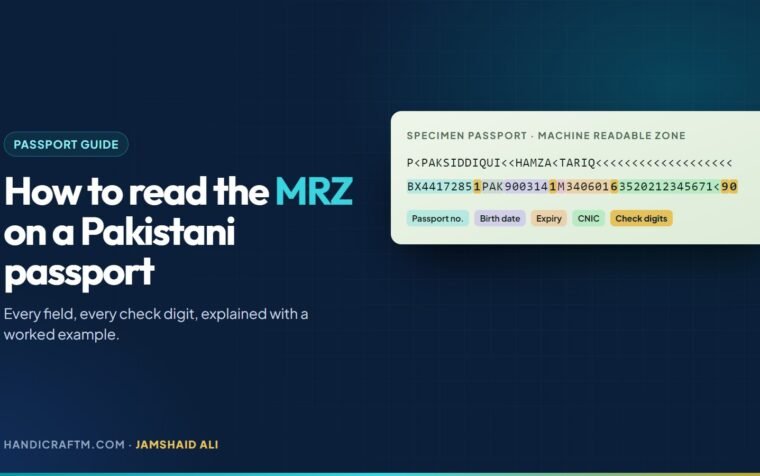
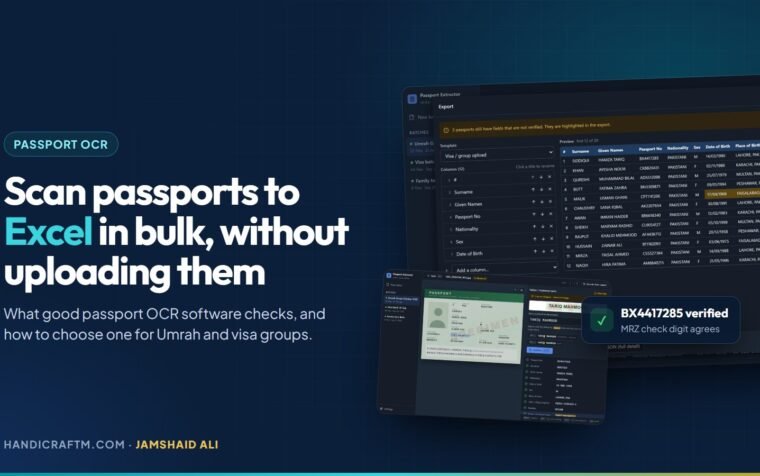
Typing passport details is slow and error-prone. Software that scans the passport and validates the MRZ check digits catches mistakes before they reach a visa form. To check one passport now, our free MRZ checker online reads the MRZ and verifies all five check digits in your browser. Our guide on reading the MRZ on a Pakistani passport explains how those check digits work.
4. Does it handle Umrah and Hajj packages?
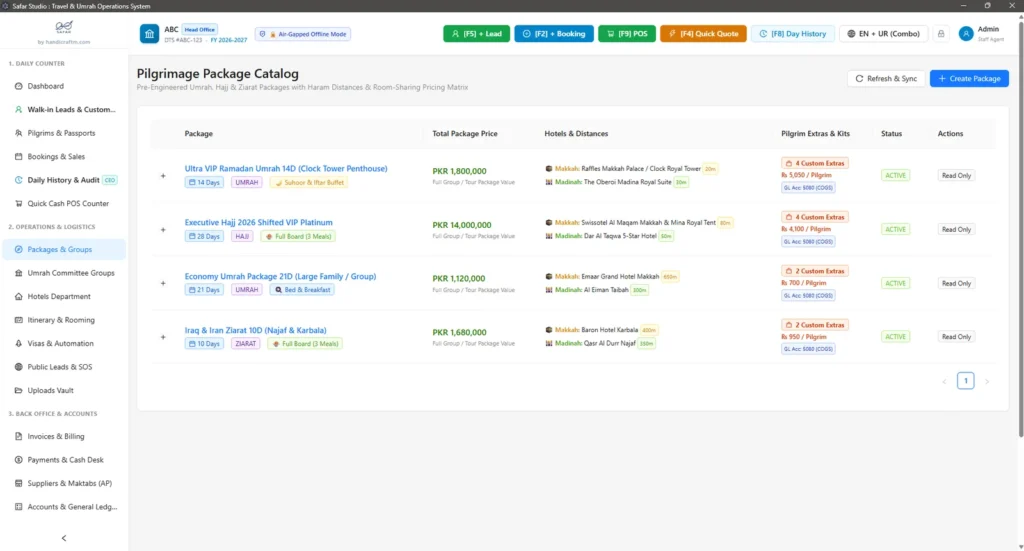
You want packages with hotels, room sharing (quad, triple, double) and a price per person, so a family quote takes minutes instead of a session with a calculator.
5. Can you send quotes on WhatsApp?
Most quotes in Pakistan go out on WhatsApp. A quick quote that produces a clean PDF or image saves time and looks professional.
6. Does it manage hotels, rooming and itineraries?
For groups you need rooming lists, bed allocation and a printable itinerary or voucher for every pilgrim.
7. Does it track visas and passport validity?
Umrah visas for Pakistani passport holders are processed by licensed operators on the Saudi Nusuk Masar platform, and current rules require confirmed hotel and transport bookings (see this overview of the 2026 Umrah visa process from Pakistan). Your software will not apply for the visa, but it should track each pilgrim’s documents, visa status and passport validity, which must be at least six months for Umrah.
8. Can it import tickets from your GDS?
Pasting the PNR or e-ticket text should add the flight segments to the booking, linked to the customer and the invoice.
9. Does it do real accounting and billing, not just invoices?
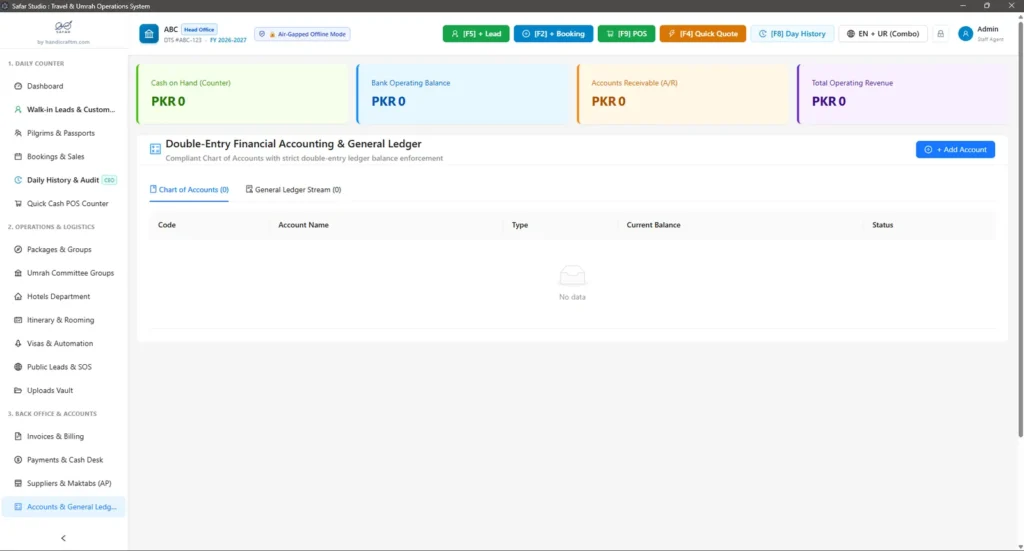
Look for double-entry accounting with customer receivables, supplier payables (airlines, consolidators, hotels and Umrah companies) and profit per booking or package. The accounting section below shows why this matters, with a worked Umrah example in PKR.
10. Can it track instalments and committees?
Many families pay for Umrah in instalments or through a committee (kameti). The software should show who paid what, and who is behind.
11. Can you control what each staff member does?
Decide who can see bank balances, give discounts or delete invoices, and keep a daily log of who did what.
12. Who owns your data, and what does it cost?
Check for automatic encrypted backups, a full export of your data to Excel, and pricing in PKR that you understand, whether monthly, yearly or one-time. Avoid systems that lock your data in.
Cloud vs desktop travel agency software
| Desktop (offline-first) | Cloud (online) | |
|---|---|---|
| Works during internet outages | Yes | No |
| Access from home or another branch | Needs sync or remote access | Yes |
| Where your data lives | Your PC, with your backups | The vendor’s servers |
| Typical pricing | One-time or yearly licence | Monthly, often per user |
| Speed at a busy counter | Fast, no page loads | Depends on the connection |
Many agencies start with desktop software at the counter and add online features, such as a customer app or a booking website, as they grow.
How should travel agency accounting work?
Travel agency accounting means tracking three things for every booking: what the customer owes you, what you owe each supplier (the airline or consolidator, hotels, the Umrah company, transport) and the profit left in between. Excel can handle this for a small agency. Once you have instalments, groups and several suppliers per booking, accounting built into your travel agency software is safer and faster.
Why is travel agency accounting different?
- Money arrives before costs: customers pay deposits weeks before you pay hotels and airlines.
- One sale, many suppliers: an Umrah package mixes tickets, hotels, visa, transport and ziyarat.
- Profit hides inside bookings: you only know the margin once every supplier cost is recorded against the booking.
- Instalments and committees: families pay over months, and every payment needs a receipt.
- Changes after the sale: refunds, reissues and cancellations change the numbers long after the invoice.
Which accounts does a travel agency need?
| Account | Type | What goes in it |
|---|---|---|
| Cash in hand | Asset | Cash received at the counter |
| Bank accounts | Asset | Transfers, cheques and mobile wallet collections |
| Customer receivables | Asset | Amounts customers still owe you |
| Supplier payables | Liability | Amounts you owe airlines or consolidators, hotels, Umrah companies and transporters |
| Sales by service | Income | Tickets, Umrah packages, visas, hotels and other services, kept separate |
| Commission income | Income | Commissions earned from airlines or suppliers |
| Cost of sales | Expense | What each service cost you from suppliers |
| Office expenses | Expense | Rent, salaries, utilities and marketing |
Worked example: one Umrah package in PKR
A family of four books an Umrah package for PKR 1,200,000 and pays a deposit of PKR 600,000. Your costs are air tickets for PKR 640,000 from a consolidator, hotels for PKR 360,000, and visa and transport for PKR 100,000 through the Umrah company. The figures are illustrative.
| Step | Debit | Credit | Amount (PKR) |
|---|---|---|---|
| 1. Invoice the family | Customer receivable | Sales: Umrah packages | 1,200,000 |
| 2. Deposit received | Bank | Customer receivable | 600,000 |
| 3. Tickets issued | Cost of sales: tickets | Payable: consolidator | 640,000 |
| 4. Hotels confirmed | Cost of sales: hotels | Payable: hotel supplier | 360,000 |
| 5. Visa and transport | Cost of sales: visa and transport | Payable: Umrah company | 100,000 |
After these entries the family still owes PKR 600,000, you owe suppliers PKR 1,100,000, and the booking shows a gross profit of PKR 100,000 (1,200,000 minus 1,100,000), about 8.3%. A simple cash sheet would show PKR 600,000 in the bank, with no hint that suppliers are owed almost twice that amount.
When the family pays the balance, debit Bank and credit Customer receivable. When you pay the consolidator, debit Payable: consolidator and credit Bank. Every entry has an equal debit and credit, which is why a correct trial balance always comes back to zero.
Excel or accounting software?
| Excel | Accounting software | |
|---|---|---|
| Cost | Free or already owned | Monthly, yearly or one-time |
| Double entry | Manual and easy to break | Automatic from each invoice and payment |
| Profit per booking | Only if you build it yourself | Built in |
| Customer and supplier balances | Separate sheets, often out of date | Always current, with ageing |
| Instalment receipts | Typed by hand | Printed from the payment |
| Audit trail | None; anyone can change a cell | Shows who did what, and when |
| Several staff | Conflicting copies of the file | One database with permissions |
| Backups | Manual | Automatic |
Excel is fine when one careful person handles a few bookings a week and reconciles regularly. The real cost of Excel is not the licence; it is the errors nobody notices.
Signs you have outgrown Excel
- You cannot say today how much each customer owes you.
- Supplier statements never match your sheet.
- You find out a package lost money after the group has returned.
- Two staff members keep different versions of the same file.
- Instalment receipts are still written by hand.
- Month-end takes days instead of minutes.
What should a travel agency invoice include?
Whether you use Excel or software, every invoice should show:
- Your agency name, address and DTS licence number (the Department of Tourist Services licenses travel agencies)
- Your NTN, and your sales tax registration if you are registered
- Invoice number and date
- Customer name and phone number
- Passenger names exactly as on their passports
- Service lines (ticket, package, visa, hotel) with travel dates
- Total, payments received and balance due
- Payment terms and your refund policy
What to look for in travel agency accounting software
- Invoices and receipts that post to the ledger automatically
- Supplier accounts for airlines, consolidators, hotels and Umrah companies (Maktabs)
- Profit per booking and per package
- Receivables ageing, so you know who to chase first
- Instalments and committees
- Daily cash desk and bank reconciliation
- Trial balance, profit and loss account and balance sheet
- Staff roles and an admin PIN for voids and refunds
- Export of all your data to Excel
- Works offline at the counter
Is free travel agency software worth it?
“Travel agency software free download” is a common search. Free and cracked versions usually come without updates, support or backups, and some are bundled with malware. When your bookings, passports and accounts live in one system, support and backups are worth paying for. A free trial of supported software is a safer way to test.
Questions to ask before you buy
- Can I try it free with my own data?
- Does it work offline?
- Is there a real Urdu interface?
- Can I export all my data to Excel?
- How are backups made, and how do I restore one?
- What will it cost after the first year?
- Who provides support, and how quickly do they reply?
- Which features are finished today, and which are only planned?
How does Safar Studio fit this checklist?
We built Safar Studio for travel agencies and Umrah operators in Pakistan. It runs offline on Windows in English, Urdu and Arabic, and covers walk-in leads, passport scanning, Umrah and Hajj packages, hotels and rooming, visa tracking, POS ticketing with PNR import, committees and double-entry accounting, with staff roles, an audit trail and encrypted backups. Plans start at PKR 2,500 per month, and every plan starts with a free one-week trial.
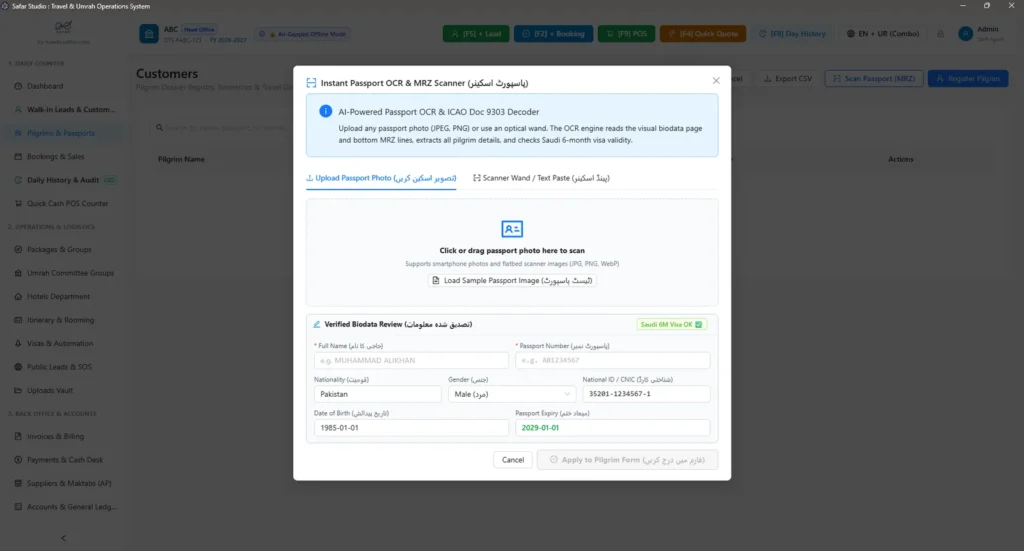
For bulk passport entry for whole groups, see Passport Extractor. And for more on how we build software and websites for this sector, visit our page for tour operators and travel businesses.
For the paperwork around each booking, our free browser tools help too: the Pakistan passport photo size tool, the Saudi visa photo resizer, the baggage allowance calculator for ticketing, and the invoice generator for Pakistan for client bills in PKR.
Summary
The best travel agency software in Pakistan is the one that fits how your counter really works: offline when the internet drops, in your staff’s language, with passport scanning, Umrah packages, visa tracking and real accounts in one place, and with your data under your control. Record both the customer side and the supplier side of every booking so receivables, payables and profit are always visible, use the 12 points above as your checklist, and test any system on a normal working day before you commit.