On this page
A Hajj and Umrah CRM is software that follows each pilgrim from the first WhatsApp message or walk-in to the day they return home: enquiry, quote, deposit, passport and documents, visa, group and rooming, installments, travel and follow-up. For Umrah, the CRM is your main record of every pilgrim and payment. For private Hajj, MoRA’s Hajj Policy 2027-2030 requires bookings and payments to run through the government’s Private Hajj Management Portal, so your CRM manages the people, documents and follow-ups around that portal.
We build Safar Studio, desktop software for travel agencies and Umrah operators in Pakistan, so we have mapped this workflow screen by screen. The rules in this guide come from the Hajj and Umrah (Regulation) Act, 2024 as published in the Gazette of Pakistan, MoRA’s Hajj Policy and Plan 2027-2030, and MoRA’s 2026 Umrah contract attestation form.
How is a Hajj and Umrah CRM different from a normal CRM?
A general CRM tracks deals. An Umrah or Hajj operator tracks people who travel together, each with documents that can stop the whole group. The differences show up on day one:
- The unit is a pilgrim inside a family or group, not a single deal. One enquiry can become eight passports.
- Documents decide the timeline: passport validity, CNIC, photos, Mahram details where required, and visa status. Our free passport size photo maker for Pakistan prepares 35×45 mm photos for the file.
- Rooms are part of the price: quad, triple and double sharing change the cost per person.
- Payments stretch over months, through installments or a committee (kameti).
- The government sets rules on who may operate, how money moves and what you report.
If you are new to CRM in general, our guide to CRM for small businesses explains the basics. The rest of this guide is specific to pilgrims.
What does the lead-to-pilgrim workflow look like?
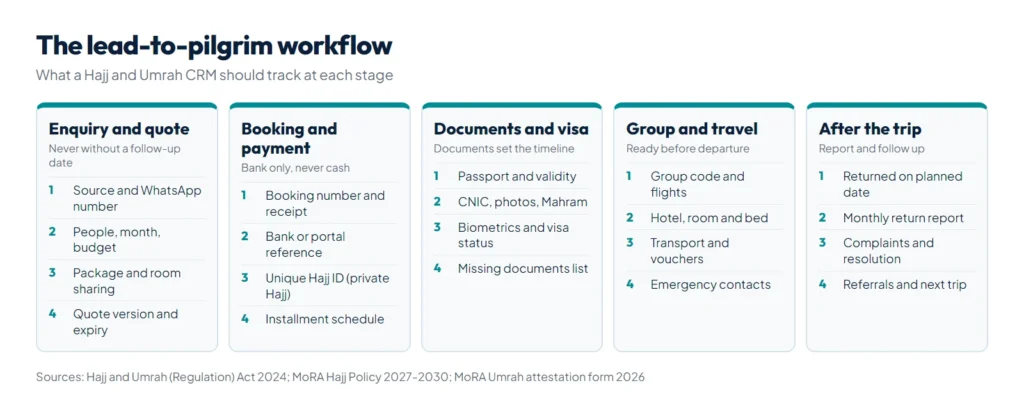
Nine stages cover almost every booking. Each one should have an owner on your staff and a list of fields that must be filled before the pilgrim moves on.
1. Enquiry from WhatsApp, a call or a walk-in
Track: name, WhatsApp number, source (walk-in, call, WhatsApp, referral, ad), Hajj or Umrah, preferred month, number of people, budget, the staff member who owns it and the next follow-up date. Use simple stages such as new, contacted, quoted and converted. The rule that matters most: no enquiry without an owner and a follow-up date.
2. Quote
Track: package, Makkah and Madinah hotels with distance from the Haram, room sharing, price per person and for the family, what is included, the date the quote expires and when it was sent on WhatsApp. Keep each version, because families often come back weeks later asking for “the price you gave us”.
3. Deposit and booking
Track: booking number, amount, payment method, bank reference, receipt number and the staff member who received it. For Umrah, take payments into your company’s bank account and issue a receipt for every one. For private Hajj the rules are stricter, as the next section explains: record the official payment reference and the pilgrim’s Unique Hajj Identification Number, not cash.
4. Passport and documents
Track: passport number, issue and expiry dates, whether the passport is still valid on the travel date with the margin the season requires, CNIC, photos, Mahram details where required, previous Umrah or Hajj, wheelchair or medical notes, and a checklist of documents received. Scanning beats typing here. Our free passport MRZ scanner reads the MRZ from a photo or camera, checks all five check digits and flags passports with less than six months left. For whole groups, Passport Extractor turns a batch of scanned passports into one Excel sheet.
5. Visa
Track: date submitted, biometrics done, status, visa number and dates, and any problem raised. A visa that is stuck should show up on a list every morning, not in a staff member’s memory.
6. Group and rooming
Track: group code, departure and return dates, flights and PNR, hotel in each city, room and bed allocation, transport, group leader and the ID badges or luggage tags printed.
7. Payments and installments
Track: the installment schedule, each amount received, balance due, overdue days and reminders sent. For the Government Hajj Scheme, MoRA notifies the installment schedule before each season, so the dates come from MoRA rather than from you. For Umrah plans and committees, your own schedule applies, and overdue balances should be visible before tickets are issued.
8. Travel
Track: who actually departed, return date, emergency contacts in Pakistan, and any complaint raised during the trip with what was done about it.
9. After the trip
Track: whether each pilgrim returned on the planned date, feedback, complaints and how they were closed, referrals, and their next intention, such as Umrah in Ramadan. Returns are not just good service: MoRA’s 2026 attestation form asks operators to report pilgrims who returned, as explained below.
Which MoRA rules affect your CRM?
The Hajj and Umrah (Regulation) Act, 2024 (Act No. XVII of 2024, published 30 August 2024) gives the Ministry of Religious Affairs power to license Hajj and Umrah group organizers, and both licensing sections refer to private limited companies. Section 13 makes the organizer liable for hardship caused by breaking the agreement with pilgrims, and complaint disposal committees can impose penalties, from warnings and fines to blacklisting and forfeiture of the performance guarantee, and order compensation. The Act’s definition of a record includes invoices, agreements, vouchers and digital information.
| Rule | Source | What your CRM should hold |
|---|---|---|
| Licensed organizers only, as private limited companies | Act, sections 5 and 10 | Company and license details on every quote, receipt and agreement |
| Organizer liable for breach of agreement | Act, sections 13 to 16 | The signed agreement and exactly what was promised: hotels, distance, rooms, transport |
| Hajj dues through designated bank accounts only; no cash | Hajj Policy 2027-2030 | Official payment references; no cash entries for Hajj dues |
| Private Hajj runs through the Private Hajj Management Portal | Hajj Policy 2027-2030 | Unique Hajj Identification Number and portal booking reference |
| Regulator gets full access to operator data | Hajj Policy 2027-2030 | Clean, complete records you can export |
| Monthly report of Umrah pilgrims who traveled and returned | MoRA attestation form, 2026 | Departure and return status for every pilgrim |
| Package, hotel and transport data for the season | MoRA attestation form, 2026 | Package records linked to hotels and transport used |
Private Hajj: the portal is the system of record
MoRA’s Hajj Policy and Plan 2027-2030 says all Hajj dues for both schemes are deposited in bank accounts notified by the Ministry, through formal banking channels only, with no cash accepted. For private Hajj it goes further: all bookings run through the Private Hajj Management Portal, each pilgrim gets a Unique Hajj Identification Number linked to identity and payment records, manual handling of data, bookings or payments is prohibited, and operators may not collect, hold or transfer pilgrim funds themselves. MoRA’s 2027 private Hajj payment alert tells pilgrims not to pay cash to any person, agent or company, and to choose packages and pay only through the Pak Hajj app or the Hajj management portal. Your CRM therefore handles enquiries, counseling, documents, groups and follow-up, and records the portal references, but it must never become a side channel for Hajj money.
Umrah: attestation and monthly returns
MoRA’s Umrah contract attestation form, issued on 14 July 2026, asks for a DTS license with at least six months of validity, current IATA membership, the contract with the Saudi Umrah company checked by the Ministry of Foreign Affairs, bank account numbers of both parties, and an attestation fee of Rs 5,000. In the undertaking, the operator states how many pilgrims it sent last year, how many returned on time and how many did not return, and agrees to give MoRA package data with hotel and transport details and monthly details of pilgrims who traveled and came back. It also refers to registration of Umrah group organizers under the Umrah Rules 2025. If your CRM records departure and return dates for every pilgrim, these reports take minutes instead of days.
Hajj vs Umrah: what changes in the CRM?
| Private Hajj | Umrah | |
|---|---|---|
| Where the booking lives | MoRA’s Private Hajj Management Portal | Your own system |
| How money moves | Through the government account and official app or portal only | Into your company’s bank account, with a receipt each time |
| Key ID | Unique Hajj Identification Number | Passport and visa numbers |
| Timing | Once a year, against a quota | Year-round, with Ramadan and holiday peaks |
| Reporting | Full data access for the regulator | Monthly travel and return details to MoRA |
| What the CRM adds | Counseling, documents, groups, training, follow-up | The full workflow, from enquiry to accounts |
What should you measure each month?
- Enquiry to booking rate, by source
- Average time from enquiry to first quote
- Bookings with documents still missing, by days to departure
- Overdue installments and total balance outstanding
- Pilgrims returned on the planned date
- Complaints opened and closed, and how long each took
- Repeat and referred pilgrims
How does Safar Studio handle this workflow?
Safar Studio is our Windows software for travel agencies and Umrah operators. It runs offline in English, Urdu and Arabic, and maps to the stages above:
- Enquiry: walk-in and phone enquiries with F5, with English and Urdu labels, followed up by stage: new, contacted, quoted and converted.
- Quote and booking: F4 Quick Quote builds a family quotation for WhatsApp or Excel from packages with hotels, Haram distances and quad, triple and double prices; F2 New Booking links pilgrims, rooms, flights and visas in one file.
- Passports and documents: scanning from a phone photo, webcam or USB MRZ reader, a pilgrim file with CNIC, Mahram, previous Umrah or Hajj and wheelchair notes, and an automatic Saudi six-month validity check.
- Visa and groups: a Saudi visa pipeline for documents, biometrics and status, rooming with bed sharing, travel vouchers, lanyard ID badges and luggage tags.
- Payments: committee groups with installments, draws and defaulter alerts, a media vault for deposit slips and CNIC scans, and double-entry accounts.
- Follow-up: a WhatsApp and email dispatcher for confirmations, reminders and alerts.
Safar Studio keeps your agency’s own records; official private Hajj bookings and payments still go through MoRA’s portal. Plans start at PKR 2,500 a month, with a free one-week trial. For the broader buying checklist, including offline use, accounting and data ownership, read our guide to travel agency software in Pakistan, and see our tour operators and travel page for websites and enquiry funnels.
Summary
A Hajj and Umrah CRM should carry each pilgrim through nine stages, from enquiry and quote to deposit, documents, visa, rooming, installments, travel and after-trip follow-up, with an owner and required fields at each stage. The rules shape the design: only licensed organizers may operate, Hajj dues move only through notified bank accounts and, for private Hajj, through MoRA’s portal with a Unique Hajj Identification Number, and Umrah operators report travel and return details to MoRA every month. To run that workflow at your counter, try Safar Studio free for a week.