On this page
- How much does pharmacy software cost in Pakistan?
- What does pharmacy software cost per year?
- What does DRAP’s 2D barcode rule mean for pharmacies?
- Which features should pharmacy software have?
- Should a pharmacy choose cloud or desktop software?
- How do you choose pharmacy software?
- How do you move a pharmacy to new software?
- Summary
- References
Pharmacy software in Pakistan starts at about PKR 2,500 to PKR 3,500 a month for a cloud system with batch and expiry tracking, on published list prices in November 2026, and the yearly cost rises with each extra user, counter, branch or FBR integration. Before you compare prices, check that the software handles batches, expiry alerts, box, strip and tablet units, salt (generic) search and the new 2D barcodes DRAP now requires on medicine packs. This guide lists published prices, works out yearly costs, explains the DRAP barcode rule and gives a checklist for choosing.
We build software and websites for healthcare businesses in Pakistan. Prices below come from each vendor’s own page in November 2026, before tax. The DRAP rule comes from official news agency reporting, because the 2026 notification text was not available on DRAP’s website when we checked. Confirm both with the vendor and with DRAP before you decide.
How much does pharmacy software cost in Pakistan?
Most vendors do not publish prices. Two Pakistani vendors with pharmacy specific plans do:
| Vendor and plan | Published price | Extras listed on the page |
|---|---|---|
| Moneypex Pharmacy POS, Standard | PKR 2,500 a month, or PKR 27,000 a year | Per month: extra user PKR 2,500, terminal PKR 500, extra branch PKR 18,000, FBR integration PKR 2,000, mobile scanning app PKR 6,500. 7 day free trial. |
| HysabOne for pharmacies | From PKR 3,499 a month, billed yearly | No setup fee, unlimited users, 14 day free trial. |
Other vendors quote per pharmacy after a demo. A custom built pharmacy system costs more up front; see our guide to custom software development cost for what drives such a quote.
What does pharmacy software cost per year?
The monthly price is only the start. These yearly figures use the list prices above for a single pharmacy, before tax:
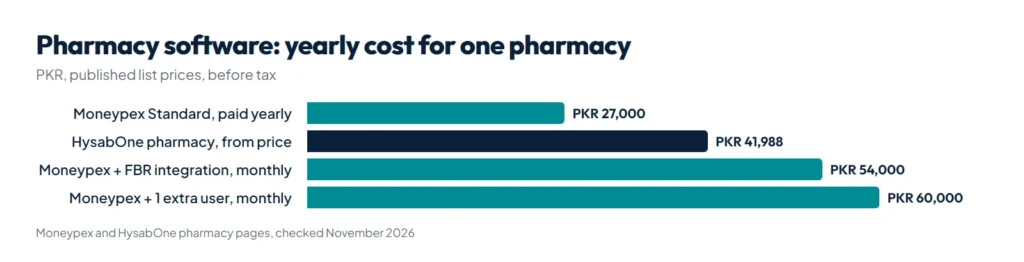
- Moneypex Standard, paid yearly: PKR 27,000.
- Moneypex Standard plus FBR integration, paid monthly: PKR 4,500 a month, or PKR 54,000 a year.
- Moneypex Standard plus one extra user, paid monthly: PKR 5,000 a month, or PKR 60,000 a year.
- HysabOne from price: PKR 3,499 a month billed yearly, or about PKR 41,988 a year, with unlimited users.
The cheapest plan is not always the cheapest for you. A pharmacy with three staff on two counters pays very differently under per user pricing than under unlimited users.
What does DRAP’s 2D barcode rule mean for pharmacies?
Under the first phase of DRAP’s Pharmaceutical Track and Trace System, registered medicines made in Pakistan or imported on or after 9 October 2026 must carry a unique 2D Data Matrix barcode and serial number, as reported by the Associated Press of Pakistan. Batches made or imported before that date are exempt and can still be sold. The duty to print the codes falls on manufacturers and importers. ARY News reported that the framework covers allopathic medicines, including biological products for human and veterinary use, and that medicines without barcodes will not be allowed for sale after the deadline.
The reports do not set a scanning duty for retail pharmacies. But the codes change what your software and hardware should handle:
- Buy a 2D imager scanner. A Data Matrix code is two dimensional, so older laser scanners that read only ordinary 1D barcodes cannot read it.
- Ask the vendor whether the software reads Data Matrix codes and can store the batch, expiry and serial number from the scan.
- Expect mixed stock for months. Old batches without the code and new batches with it will sit on the same shelf, so the software must handle both.
Which features should pharmacy software have?
| Feature | Why a pharmacy needs it |
|---|---|
| Batch and expiry tracking | The same medicine arrives in batches with different prices and expiry dates |
| Near expiry alerts and reports | Return or sell stock before it expires. Moneypex lists alerts at 30, 60 and 90 days; HysabOne lists a counter warning before near expiry stock is sold |
| Box, strip and tablet units | You buy by the box and sell by the strip or tablet |
| Salt or formula search | Offer a substitute with the same generic when a brand is out of stock |
| Medicine database | Saves typing thousands of items. Moneypex says it preloads more than 25,000 medicines registered in Pakistan |
| Supplier purchases and returns | Distributor bills, bonus quantities, discounts and expiry returns |
| 2D barcode scanning | Reads the new DRAP Data Matrix codes |
| FBR integration | Needed only if your pharmacy falls under FBR’s POS integration rules |
| User roles | Separate logins for the pharmacist, counter staff and owner |
| Backups and export | Your stock and sales data in Excel if you change vendor |
Whether your pharmacy must integrate with FBR depends on FBR’s Tier-1 retailer rules, which our guide to POS software in Pakistan explains. For managing stock beyond the counter, see inventory management software in Pakistan.
Should a pharmacy choose cloud or desktop software?
| Question | Cloud (monthly or yearly plan) | Desktop (installed on the counter PC) |
|---|---|---|
| Internet outage | Needs an offline mode, or sales stop | Keeps working |
| Owner checks sales from home | Yes, from a phone or laptop | Only with remote access set up |
| Several branches | Shared stock and reports by design | Needs syncing between shops |
| Backups | Done by the vendor | Your job, and often forgotten |
| Cost pattern | Small payment every month or year | Larger one time license, then yearly support |
| Updates | Automatic | Installed by you or the vendor |
For a single pharmacy in an area with stable internet, cloud is usually simpler. If outages are common, ask for offline mode or keep a desktop system with a daily backup to a USB drive or cloud folder. Whatever you choose, a pharmacy that loses its sales and stock data loses its purchase history with every distributor, so test a restore from backup once before you rely on it.
How do you choose pharmacy software?
- Count your users, counters and branches. This decides which pricing model is cheaper.
- Ask for a demo with your own medicines, including one item sold by the tablet and one with two batches.
- Test the expiry report and the near expiry warning at the counter.
- Scan a new pack with a 2D code during the demo.
- Check offline use. Ask what happens to sales during an internet outage and how they sync later.
- Ask about data export and support hours, including evenings, when many pharmacies are busiest.
- Use the free trial on real sales for a few days before you pay for a year.
How do you move a pharmacy to new software?
- Clean your item list: one entry per medicine and pack size, with the salt name.
- Count stock by batch and expiry on the switch day and enter it as opening stock.
- Enter open supplier balances so purchases and payments start correctly.
- Train every counter user on sale, return and substitute search before going live.
- Run the expiry report weekly for the first months and act on it.
For the occasional bill while you choose, our free invoice generator for Pakistan makes PKR invoices with NTN and sales tax in your browser.
Summary
Pharmacy software in Pakistan costs from PKR 2,500 a month, or PKR 27,000 a year, on Moneypex’s published Standard plan, and from PKR 3,499 a month billed yearly on HysabOne’s pharmacy plan, with extras for users, counters, branches and FBR integration. Choose on batches, expiry alerts, units, salt search and support for DRAP’s 2D Data Matrix codes, which medicines made or imported from 9 October 2026 must carry. Buy a 2D scanner, test with your own stock and do a full count before you switch. For quick bills, use our free invoice generator, and if you need a pharmacy system built around your process, see our work for healthcare businesses.